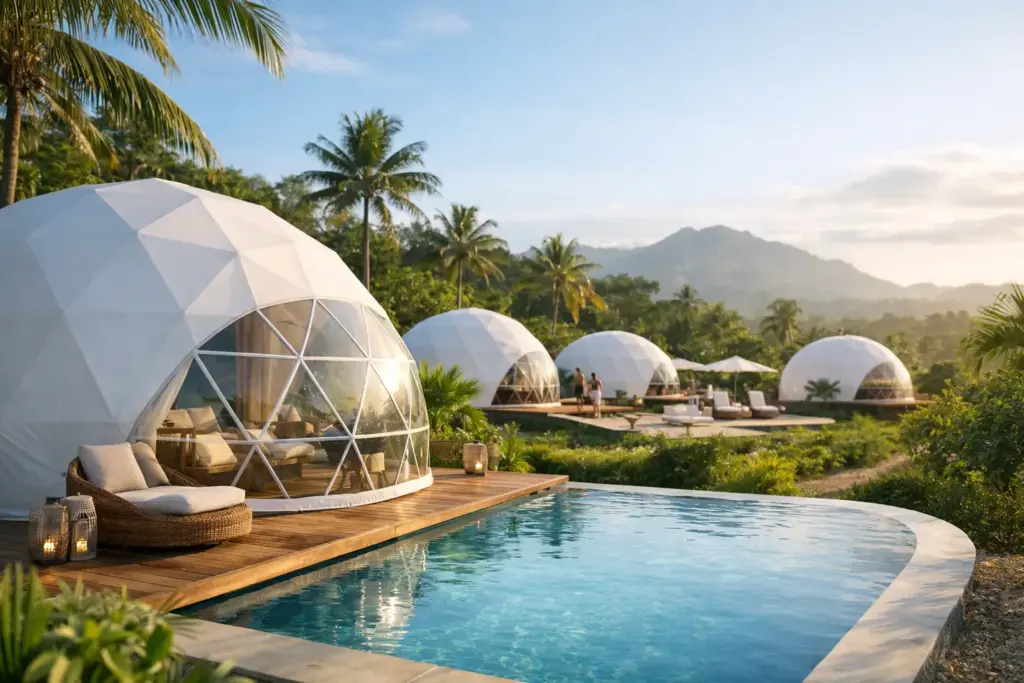
A standard guest room can sell for a night. A memorable stay can shape an entire property’s reputation. That is why resort dome structures are gaining serious traction across the outdoor hospitality market. For resort owners, retreat operators, and land developers, they offer something rare: a design-forward accommodation type that feels immersive to guests and practical to operate.
The appeal is not just visual, though the visual impact is undeniable. A well-placed dome can transform underused acreage into premium inventory with panoramic views, a sense of privacy, and an experience that feels distinct from conventional lodging. For properties trying to raise average nightly rates, extend seasonal demand, or stand apart in a crowded market, that difference matters.
What makes resort dome structures so valuable
Resort dome structures sit at the intersection of guest experience and operational efficiency. They feel elevated, but they are not purely aesthetic investments. They are commercial assets designed to help hospitality businesses grow without taking on the full burden of traditional construction.
That matters because many operators face the same challenge. They have land, demand, and a vision for expansion, but they do not want years of development complexity, major site disruption, or a build process that limits flexibility. Domes answer that challenge with a lighter footprint and a faster path to opening new accommodations.
From a guest’s perspective, the value is immediate. The geometry creates an enveloping interior that feels intimate without feeling small. Large windows and optional transparent ceiling panels turn the surrounding landscape into part of the stay. Guests are not simply booking shelter. They are booking atmosphere, privacy, and a stronger connection to place.
From an operator’s perspective, the business case is equally compelling. Domes can support premium pricing because they deliver a differentiated lodging experience. They can also be deployed in phases, which is especially useful for owners who want to validate demand before scaling to a larger footprint.
The business case behind resort dome structures
In hospitality, expansion decisions are rarely about aesthetics alone. Owners want assets that support revenue growth, fit the land, and stay manageable over time. Resort dome structures work well in this environment because they can shorten the distance between concept and cash flow.
Traditional building can be slow, capital-intensive, and highly disruptive to an existing resort environment. Domes offer a different path. Modular systems, streamlined installation, and reduced site disturbance make them attractive for properties that want to add keys without turning the guest experience into an active construction zone.
There is also a useful middle ground here. Domes are not a shortcut in the sense of sacrificing quality. Premium models are engineered for durability, insulation, and all-season performance. That means operators can pursue a luxury positioning while still making decisions that support practical operations.
The ROI conversation depends on the market, the amenity package, and the property’s pricing strategy. A dome in a remote wellness retreat may perform differently than one at a ski-adjacent resort or event venue. Still, the pattern is consistent: when the design is strong and the guest experience is intentional, dome accommodations often command attention quickly and justify higher rates than standard alternatives nearby.
Why guests choose domes over conventional rooms
Travelers increasingly want stays that feel curated rather than generic. This is especially true in premium outdoor hospitality, where guests are willing to pay more for privacy, scenery, and a sense of escape. A dome naturally supports that expectation.
Its shape changes how the space feels. Interiors can be styled with a clean, modern restraint or a warmer sanctuary-like atmosphere, depending on the brand. Either way, the structure itself becomes part of the storytelling. Guests remember waking up to forest views, mountain light, desert skies, or snowfall through a clear panel. They remember the mood of the space, not just the square footage.
That emotional pull matters because memorable stays are easier to market. They perform better in photography, encourage repeat visits, and generate stronger word of mouth. In a sector where guest acquisition can be expensive, accommodations that market themselves through experience have a clear advantage.
There is a trade-off, of course. A dome should not be treated as a novelty with no supporting hospitality plan. If the bed, climate control, bathroom solution, and arrival experience are not aligned with the nightly rate, the concept falls flat. The structure creates interest, but the operational details are what sustain reputation.
Design flexibility without losing operational control
One of the strongest advantages of resort dome structures is their adaptability. They can serve as luxury sleeping units, spa spaces, wellness studios, private dining rooms, event lounges, or multi-use hospitality environments. That gives owners room to design a property with layered revenue opportunities rather than relying on accommodations alone.
This flexibility is especially valuable for phased development. An operator may begin with a small number of guest domes and add support spaces later. Another property may start with event or wellness programming and then introduce overnight inventory once demand is established. The ability to scale without rethinking the entire concept can reduce risk.
Relocation flexibility is another consideration. Not every land strategy is fixed for decades, and not every operator wants to commit to permanent structures in every area of a property. Dome systems can offer a more agile approach, which is useful when market conditions, programming needs, or land use plans evolve.
That said, flexibility should not be confused with a lack of planning. Premium results depend on site design, circulation, privacy, utility integration, and brand cohesion. The properties that perform best tend to treat each dome as part of a larger guest journey rather than a standalone object placed on the land.
All-season performance changes the revenue model
Seasonality can put pressure on outdoor hospitality. A property may enjoy strong summer demand and then slow dramatically when temperatures shift. For many owners, that is where the right dome specification becomes especially important.
Insulated, weatherproof, energy-efficient domes can support year-round use, which changes the economics. Instead of relying on a narrow peak season, operators can build programming for colder months, shoulder seasons, and weather-driven experiences. Snowfall, rain, and cool nights can become part of the appeal rather than a reason to close inventory.
This is not automatic. Year-round viability depends on climate, mechanical systems, insulation quality, and the guest expectations tied to the rate. A four-season strategy in the Rockies requires a different specification than one in the Southeast. But for operators willing to match the product to the environment, all-season domes can meaningfully improve utilization and revenue stability.
Where luxury meets speed to market
For developers and resort owners, timing matters. A strong concept loses momentum when the build cycle drags on too long. Resort dome structures offer a compelling answer because they can help properties move from planning to launch with greater efficiency.
This is one reason they are drawing attention from buyers who think in terms of both brand and balance sheet. A dome can elevate the visual identity of a property while also reducing some of the friction associated with conventional expansion. Less disruption on site can preserve the guest environment. Faster deployment can help operators begin generating returns sooner. Scalable rollout can align capital investment with actual demand.
That combination is powerful. It allows an owner to build the business with more control, especially when entering a new hospitality category or testing a fresh segment such as wellness travel, romantic escapes, or event-driven stays.
For serious operators, the question is no longer whether guests will respond to distinctive outdoor accommodations. They already are. The better question is which structures can deliver the experience guests want while still meeting the demands of durability, efficiency, and long-term commercial use. That is where premium suppliers such as StarWild Domes stand apart – by pairing elevated design with practical deployment and scalable hospitality thinking.
Choosing the right dome strategy for your property
Not every property needs the same dome mix, layout, or finish level. A luxury retreat may prioritize privacy and spa-like interiors. A family-focused resort may need larger footprints and resilient finishes. An event venue may care more about multi-use space and visual impact than overnight density.
The right strategy starts with the business model. Are you trying to increase ADR, open a new revenue stream, extend the season, or activate unused land? Once that goal is clear, decisions around dome size, placement, insulation, amenities, and expansion become much easier.
The most successful projects tend to think beyond the structure itself. They consider arrival, views, spacing, acoustics, utilities, maintenance, and how each unit contributes to the property’s identity. A beautiful dome in the wrong location can underperform. A well-planned dome experience can become the centerpiece of the brand.
The opportunity here is larger than adding a few distinctive rooms. It is about shaping a hospitality product that feels current, premium, and commercially sound. For owners who want to create places where luxury meets nature without inheriting the full complexity of traditional development, resort dome structures offer a smart and credible path forward.
The properties that win in the next chapter of outdoor hospitality will not simply offer a place to sleep. They will offer a setting guests want to remember – and a business model owners can confidently grow.