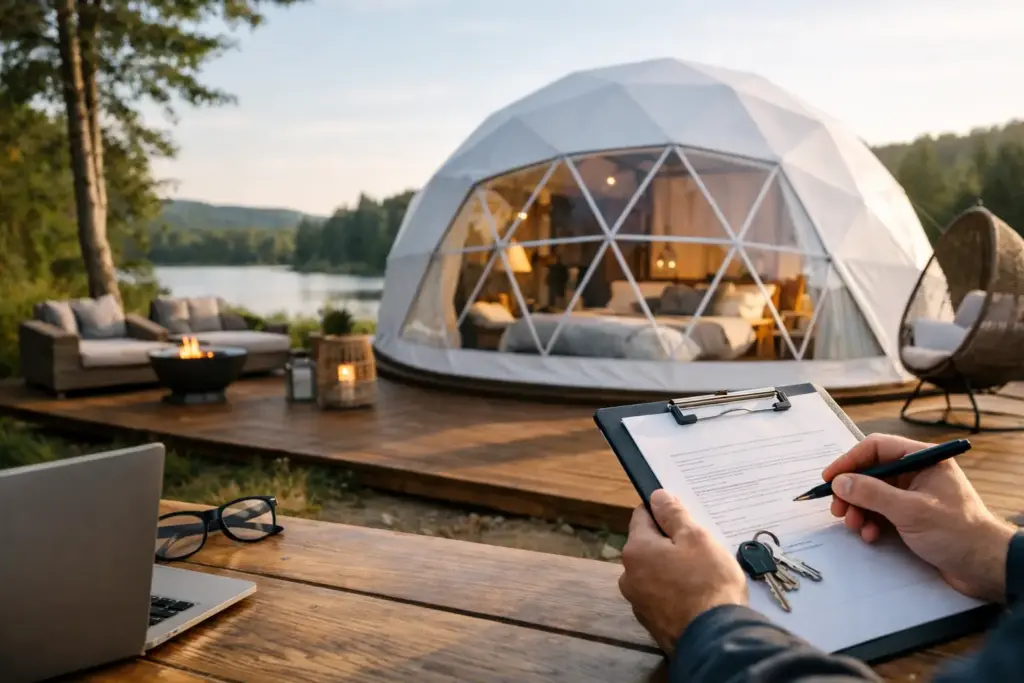
A dome can look extraordinary in a rendering and still become a costly mismatch once it hits the ground. For buyers in outdoor hospitality, a strong glamping dome buyer guide starts with a simple question: Are you purchasing a beautiful structure or a revenue-producing accommodation asset?
That distinction matters. A dome for occasional private use can tolerate compromises that a commercial site cannot. If your goal is to add premium inventory, extend seasonal demand, and build your business with a design-forward guest experience, the buying criteria become far more specific.
What a glamping dome buyer’s guide should help you decide
The right dome is not just about shape or visual appeal. It is about how well the structure supports occupancy, operations, guest comfort, and long-term returns. Buyers often begin by focusing on photos, window placement, or floor area. Those details matter, but they should come after the bigger commercial questions.
Start with your business model. A wellness retreat, a couples resort, and an event venue may all want luxury domes, but they need different layouts, privacy strategies, and utility plans. A dome that performs well as an intimate overnight suite may not be the right fit for a yoga pavilion, spa treatment room, or multi-unit expansion.
This is where disciplined buying pays off. The best decision is rarely the cheapest structure or the largest footprint. It is the dome that fits your land, climate, guest expectations, and rate strategy without creating operational drag.
Buy for climate first, aesthetics second
In hospitality, guest comfort is part of your brand. If a dome is too hot in summer, difficult to heat in winter, or noisy in storms, the design loses its value quickly. Year-round performance should sit near the top of any serious evaluation.
Insulation is one of the clearest indicators of commercial viability. A seasonal shell may work for fair-weather glamping, but operators in most US markets benefit from a structure designed for broader occupancy windows. Better insulation supports temperature stability, lowers energy demand, and makes it easier to deliver a premium stay rather than a novelty stay.
Weatherproofing also deserves careful attention. Snow load, wind resistance, moisture management, and material durability all affect long-term operating costs. A dome installed in the Rockies, the Pacific Northwest, or the Northeast faces very different environmental pressure than one placed in a milder southern market. The right answer depends on your site.
Transparent panels are another example of trade-offs. They create dramatic views and a memorable sense of immersion, which can lift ADR when used well. But more transparency can also affect privacy, heat gain, and temperature control. For some operators, a panoramic ceiling panel is a signature feature. For others, a more balanced glazing plan creates a better guest experience across all seasons.
Size matters, but layout matters more
Many buyers assume a larger dome automatically means a more luxurious product. Sometimes it does. Just as often, it increases cost without improving the guest experience enough to justify the difference.
The better question is how the space will function. Will the unit include only a sleeping area and lounge, or do you plan to integrate a bathroom, kitchenette, or soaking tub? Will the dome sit on its own or connect to a deck, spa area, or secondary service structure? A compact, well-planned dome can outperform a larger one if the layout supports privacy, circulation, and visual impact.
For commercial operators, furniture planning should happen early. Ceiling height, wall curvature, bed orientation, mechanical placement, and storage options all shape how premium the space feels in use. A dome can have generous square footage on paper and still feel awkward if the layout ignores how guests actually move through the room.
Installation should support speed and site integrity
One of the strongest reasons buyers choose domes is to avoid the timeline and disruption of conventional construction. That advantage is real, but only if the installation model fits your property and launch schedule.
Modular or efficient installation methods can reduce labor time, simplify deployment, and limit disturbance to the surrounding landscape. For hospitality operators, that matters beyond convenience. Less disruption can preserve the natural setting that gives the stay its value in the first place.
It also affects project timing. If you are trying to open before peak season, every delay impacts revenue. Ask direct questions about foundation requirements, utility integration, site access, and how installation changes across terrain types. A beautiful structure that arrives with hidden complexity can push back opening dates and erode early returns.
Relocation flexibility is another factor many buyers overlook. Not every operator needs it, but for developing properties, pilot projects, or event-driven venues, the option to reposition or expand can be commercially useful. It gives you room to test demand before making larger commitments across the site.
Evaluate domes as hospitality assets, not just structures
The strongest buyers look past product specs and ask how the dome performs as part of a guest-facing business. This shifts the conversation from materials alone to revenue logic.
Can the dome support premium pricing in your market? Does it create a distinctive stay worth photographing, reviewing, and recommending? Will it help you attract couples, wellness travelers, or private group bookings that raise the lifetime value of the property?
Luxury in outdoor hospitality is not excess for its own sake. It is thoughtful design paired with comfort and ease. Guests want immersion in nature, but they also expect climate control, quiet, privacy, and a sense of polish. When those elements come together, a dome becomes more than an accommodation. It becomes a reason to book.
That is where ROI potential becomes more credible. Strong rate performance usually comes from a combination of design appeal, operating reliability, and season length. If one of those pieces is weak, the numbers can soften quickly.
Questions to ask before you commit
A good glamping dome buyer guide should leave you with sharper questions, not just more inspiration. Before selecting a supplier, ask how the structure is engineered for your region and what options exist for insulation, weather resistance, and utilities. Ask what is included versus what is custom. Ask how installation is managed and what support is available if you plan to scale from one unit to several.
You should also ask what kind of operator the product is really built for. Some domes are ideal for lifestyle buyers or occasional hosts. Others are designed for serious hospitality use, where uptime, durability, and repeatable deployment matter. That distinction affects everything from guest satisfaction to maintenance planning.
If you are developing a premium property, design support and project guidance matter as much as the shell itself. The right partner helps you think through platform design, placement, views, spacing between units, and how to preserve a sense of sanctuary across the site. StarWild Domes serves this part of the market by aligning luxury presentation with practical deployment for commercial operators.
Red flags that deserve a second look
The first red flag is vague performance language. If a supplier talks broadly about durability but offers little clarity on insulation, weather handling, or commercial use cases, press further. Premium hospitality requires more than visual confidence.
The second is poor alignment between the dome and your operating model. If you want four-season revenue but the structure is better suited to mild-weather use, the mismatch will show up in occupancy and guest reviews. If you need scalable deployment but every unit requires a bespoke process, expansion may become slower and more expensive than expected.
The third is treating the dome as the whole concept. Even the best structure needs the right site planning, interiors, utility strategy, and guest journey around it. A profitable glamping property is an ecosystem, not a single product purchase.
The best dome is the one that fits your next five years
A dome purchase should serve where your business is going, not just what you want to launch this season. That may mean choosing a model with stronger all-season performance, even if the upfront cost is higher. It may mean selecting a supplier that can support multi-unit growth rather than a one-off install. Or it may mean resisting oversized designs in favor of units that deliver better margins and faster payback.
The most successful buyers stay clear-eyed about both sides of the opportunity. They understand the emotional draw of sleeping under the stars, and they pair that vision with practical questions about durability, efficiency, installation, and rate strength. That is where luxury meets discipline and where a dome begins to earn its place on the land.
Choose with that horizon in mind, and your dome will do more than elevate the view. It will help shape a property guests remember and a business built to last.