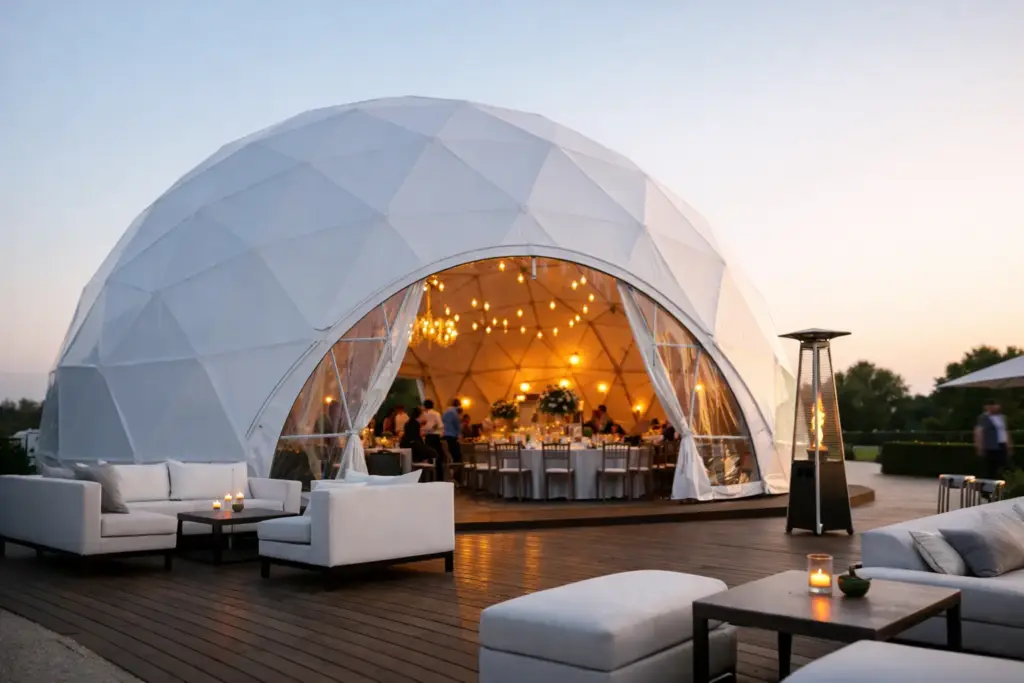
A standard event space is easy to forget. The setting may be functional, but it rarely becomes part of the story guests tell afterward. Event venue dome structures change that equation. They give hospitality properties and event-focused developments a way to create a destination within the destination – one that feels immersive, premium, and commercially smart.
For owners building a resort, retreat property, or outdoor venue, that distinction matters. Guests are not only paying for square footage. They are paying for atmosphere, novelty, comfort, and the sense that they have chosen a place with character. A dome can deliver that emotional pull while also solving practical concerns around installation speed, weather resistance, and year-round use.
What makes event venue dome structures so effective
The appeal starts with design. Geodesic domes have a sculptural presence that stands apart from tents, banquet halls, and conventional pavilions. Their curved form feels modern, elevated, and close to nature at the same time. For venues competing in the premium end of the market, that visual identity can do real work.
It also translates well across different event categories. A dome can host weddings, wellness gatherings, private dinners, branded activations, corporate retreats, and seasonal experiences without feeling overly fixed to one use case. That flexibility is valuable for operators who need each asset on the property to support more than one revenue stream.
There is also a guest psychology factor that should not be underestimated. People respond to spaces that feel distinctive. Panoramic views, filtered natural light, and optional transparent panels create a strong sense of occasion before any decor is added. In event business terms, that means the structure itself helps carry the guest experience.
Design-led spaces with business value
Beautiful venues attract attention, but attractive design alone is not a business model. The stronger case for event venue dome structures is that they combine visual impact with operational efficiency.
Traditional event buildings often come with longer timelines, more site disruption, and greater capital intensity. Depending on the jurisdiction, a permanent build can also involve a more complicated path through approvals, utilities, and phased construction. A dome structure will not erase every planning requirement, but it can reduce the friction involved in bringing a new hospitality concept to life.
That speed matters when seasonality is part of your revenue picture. If you are trying to capture wedding demand, launch a retreat program, or add event inventory before peak travel periods, the ability to deploy faster can protect revenue that would otherwise be delayed.
For many operators, the stronger advantage is optionality. A dome may begin as an event venue, then expand into adjacent uses such as lounges, spa spaces, dining concepts, or overnight accommodations. This is where the structure becomes more than a venue feature. It becomes a scalable hospitality asset.
Where domes fit best in the event market
Not every property needs a dome, and not every event concept will benefit equally. The best fit tends to be venues where nature, architecture, and guest experience are all part of the brand promise.
Resorts can use dome structures to create private event settings that feel more exclusive than a main lodge function room. Retreat operators can build programming around movement, meditation, workshops, and shared dining in a space that feels intentional rather than improvised. Wedding venues can use a dome as a ceremony site, reception environment, or premium weather-protected alternative to open-air setups.
There is also a strong case for landowners and developers launching event-led hospitality concepts from the ground up. In those cases, a dome can establish the visual identity of the property early, without requiring a fully built campus on day one. That phased approach can be especially attractive when capital is being deployed strategically.
The real ROI question
When buyers evaluate event infrastructure, the conversation usually starts with cost. It should quickly move to return.
The right dome structure can support premium pricing because it creates a setting guests perceive as rare and elevated. That matters for event bookings, but it also matters for photography, social sharing, and word-of-mouth demand. A venue that looks distinctive in every season has a marketing advantage built into the product itself.
Revenue potential often improves further when the dome is not limited to occasional events. Operators who get the best returns typically program the space across multiple business lines. A wedding on Saturday, a wellness session on Monday, a corporate offsite midweek, and a private dining experience the following weekend is a very different model from a venue that sits idle between major bookings.
There are trade-offs, of course. If your market expects very large guest counts, a single dome may not replace a full-scale event hall. If your business depends on highly specialized back-of-house infrastructure, planning needs to be more deliberate. The point is not that domes fit every event strategy. It is that they often deliver stronger returns when used with clear programming and realistic capacity planning.
All-season use changes the math
One of the biggest mistakes in outdoor hospitality is building for the brochure photo rather than the operating calendar. A structure can look remarkable in summer and still underperform if it becomes difficult to heat, cool, or weatherproof the rest of the year.
That is why construction quality matters. Insulation, durable exterior materials, energy efficiency, and a weather-resistant envelope all affect whether a dome remains a practical commercial space beyond the mildest months. In much of the US and Canada, all-season viability is not a nice extra. It is central to revenue stability.
For event operators, this extends booking confidence as well. Clients want beauty, but they also want certainty. A premium dome that protects comfort in rain, wind, cold, or strong sun gives venues a stronger sales position. It reduces the need to frame every outdoor booking as a weather gamble.
Installation and site impact matter more than most buyers expect
Many hospitality owners start with the guest-facing vision, then discover that construction logistics shape the project just as much. Site access, disruption, terrain sensitivity, and the ability to preserve the natural character of the land all influence final decisions.
This is another area where dome structures can be compelling. Modular systems are often easier to install than conventional buildings, and they can require less invasive site intervention depending on the project. For properties selling a connection to landscape, that lighter footprint has both aesthetic and operational value.
Relocation flexibility can matter too. Some owners want a long-term anchor structure. Others want room to evolve the site as demand changes. A venue asset that can be repositioned or expanded later offers a different kind of security than a fixed building with no practical adaptability.
What sophisticated buyers should evaluate
The dome market is not uniform. Two structures may look similar in photos and perform very differently in real conditions.
Serious buyers should evaluate how the structure will function over time, not just how it appears on launch day. That means looking at insulation strategy, weather resistance, interior comfort, maintenance demands, and how the structure supports guest expectations at the price point you intend to charge. It also means considering whether the supplier understands hospitality operations, not only fabrication.
For premium venues, design details matter because they influence both perception and performance. Panoramic glazing can elevate the guest experience. Transparent ceiling panels can create a memorable nighttime atmosphere. But those choices need to be balanced with climate, privacy, and thermal comfort. Good design is rarely about adding every feature. It is about selecting the right combination for your market and business model.
This is where a specialized partner becomes valuable. Companies such as StarWild Domes serve operators who need more than a shell. They need a structure that supports guest satisfaction, installation efficiency, and long-term commercial use.
A venue that helps build your brand
The strongest event spaces do more than host gatherings. They shape perception. They tell guests, planners, and partners what kind of experience your property stands for.
Event venue dome structures work because they meet that branding challenge without losing sight of business fundamentals. They are visually compelling, adaptable across use cases, and capable of supporting premium hospitality when specified correctly. For owners looking to build their business through design-led outdoor experiences, that combination is difficult to ignore.
The most valuable venue investments are the ones that keep creating reasons to return. A well-executed dome does exactly that – not by trying to imitate a conventional event space, but by offering something far more memorable.