
A dome can look effortless from the outside – light on the land, dramatic in profile, and perfectly suited to a premium guest experience. But geodesic dome structural details are what determine whether that visual promise turns into a durable, revenue-producing hospitality asset or a high-maintenance headache.
For resort owners, retreat operators, and developers, this is where design and business performance meet. The frame geometry, load paths, membrane connections, insulation strategy, foundation interface, and weatherproofing details all influence how the structure performs across seasons, how comfortably guests sleep, and how much operational friction your team deals with after opening.
Why geodesic dome structural details matter in hospitality
In a consumer setting, a dome may be judged by its look alone. In outdoor hospitality, that standard is far too low. A dome must carry snow and wind loads, manage condensation, support mechanical systems, protect interior finishes, and maintain a refined guest environment while operating through heavy turnover and changing weather.
That is why structural details should never be treated as background engineering. They affect occupancy windows, maintenance cycles, energy use, and even pricing power. A dome that feels quiet, stable, insulated, and polished can support higher nightly rates than one that looks attractive in marketing photos but underperforms in real use.
The frame is the starting point
When people think about dome construction, they usually picture triangular geometry. That shape matters because it distributes loads efficiently across the shell. But not all frames are equal, and the differences show up quickly in commercial use.
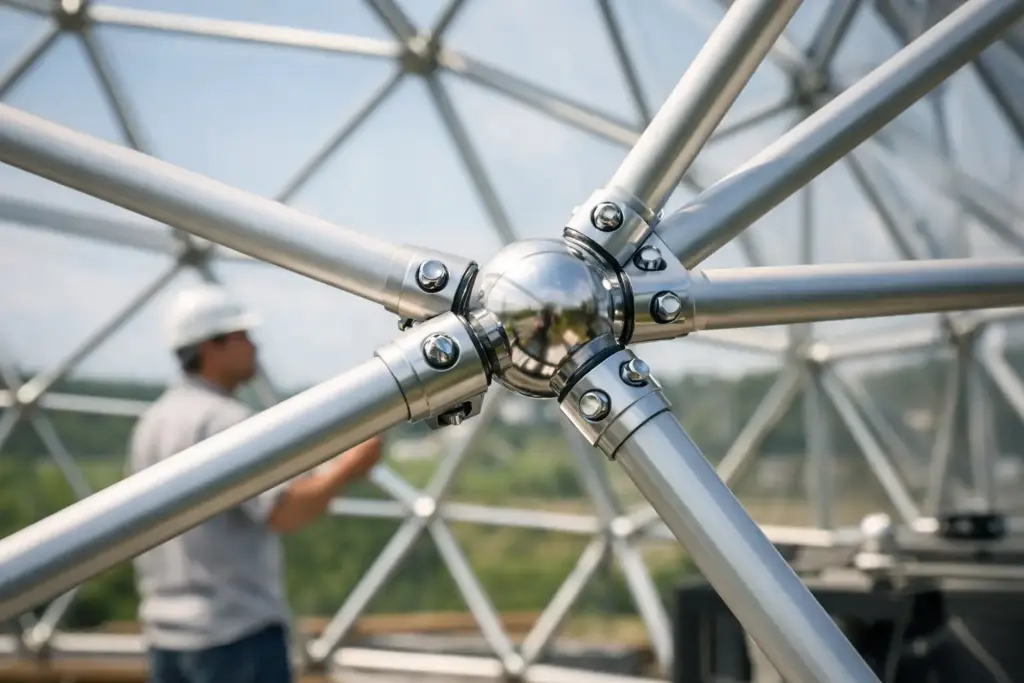
Material selection is one of the first structural decisions. Steel framing offers high strength and excellent long-term durability, especially in demanding climates. Aluminum can reduce weight and simplify handling, but the right choice depends on span, environment, corrosion exposure, and how the dome is being used. For a hospitality project expected to operate year-round, the frame has to do more than stand up. It must remain dimensionally stable under repeated loading, support interior build-outs, and hold tolerances that keep the outer envelope performing properly.
Connection points are just as important as the members themselves. The hub and strut system is where structural theory meets field reality. Weak or poorly protected connections can create movement, noise, water vulnerability, or premature wear. Well-executed joints improve rigidity and make installation more predictable, which matters when you are trying to launch on schedule and avoid expensive callbacks.
Load distribution and climate response
A well-designed dome frame manages loads by spreading them across the geometry rather than concentrating stress in a few points. That is one reason domes are attractive in snow and wind regions. Still, performance is never one-size-fits-all.
A dome in a mild desert climate will not require the same structural approach as one installed in a mountain resort or a northern four-season property. Snow load ratings, wind exposure, elevation, and freeze-thaw conditions all influence the structural specification. For commercial buyers, this is not a technical footnote. It is a core part of protecting uptime and preserving guest confidence.
The foundation connection is where many problems begin
Some of the most important geodesic dome structural details are hidden near the ground. The connection between the dome and its platform or foundation controls stability, levelness, moisture protection, and long-term durability.
A dome can be paired with a deck system, engineered platform, slab, or other site-responsive foundation approach. The right solution depends on terrain, permitting conditions, drainage, frost depth, and whether relocation flexibility matters to the project. In hospitality settings, minimal site disruption is often a major advantage, but that does not mean the structural interface should be simplified.
Anchoring must account for uplift, lateral forces, and settlement risk. If the base ring is not properly integrated with the support system, the dome may experience stress at door openings, envelope tension changes, or uneven wear. These are not cosmetic issues. They can affect weather sealing, operational comfort, and the perceived quality of the stay.
The outer envelope does more than keep rain out
Luxury glamping is built on the promise of immersion without exposure. That promise depends heavily on the dome skin and the way it is attached, tensioned, sealed, and insulated.
In practical terms, the membrane system has to resist UV exposure, wind-driven rain, temperature swings, and repeated expansion and contraction. It should also maintain a crisp architectural appearance over time. If the outer skin sags, stains, or collects moisture in vulnerable areas, the guest experience declines fast.
The attachment details matter here. Trim edges, seam treatments, flashing transitions, and tensioning systems all contribute to weatherproofing and finish quality. This is especially true around penetrations for doors, windows, transparent ceiling panels, HVAC routing, and utility connections. These points often determine whether a dome remains watertight and energy efficient after years of operation.
Insulation and condensation control
For operators targeting year-round occupancy, insulation is not a luxury add-on. It is fundamental to comfort, energy performance, and asset protection. The challenge is that dome geometry behaves differently than a conventional wall and roof assembly.
Insulation strategy should work with the membrane and frame system, not fight against it. Thermal bridging, vapor movement, and interior humidity all need to be managed carefully. Without proper detailing, warm interior air can meet cold surfaces and create condensation. Over time, that can affect finishes, air quality, and maintenance costs.
Good detailing creates a more stable interior environment. Guests notice this immediately, even if they cannot name the reason. The space feels quieter, warmer in winter, cooler in summer, and more polished overall. For an upscale property, that difference supports both guest satisfaction and stronger ROI potential.
Openings are structural and experiential at the same time
Doors, panoramic windows, and transparent roof sections are often what make a dome memorable. They are also some of the most sensitive structural zones in the building.
Every opening interrupts the continuity of the shell, so the surrounding frame has to compensate. Poorly detailed openings can introduce stress concentrations, air leakage, water intrusion, and heat loss. Well-designed openings, by contrast, deliver the visual drama guests expect while preserving the structural integrity of the dome.
This is where premium design earns its value. The best hospitality domes balance expansive views with disciplined engineering. Guests see light, sky, and landscape. Operators benefit from weather performance, envelope durability, and a layout that supports furniture, amenities, and daily use.
Interior support matters more than many buyers expect
A dome is not just a shell. In hospitality use, it often carries lighting, climate equipment, window treatments, decorative finishes, and sometimes bathroom or partition integrations. Those loads need to be anticipated early.
Structural detailing should account for how the interior will actually function. If mechanical systems are added as an afterthought, routing can become awkward and visible. If mounting points are not planned properly, the result may be field improvisation that compromises appearance or performance.
For developers building multiple units, consistency matters. Repeatable structural details make installation faster, maintenance simpler, and future scaling more predictable. That operational clarity is one reason experienced partners stand apart from generic suppliers.
What smart buyers should ask before specifying a dome
Not every operator needs the same technical solution, but every serious buyer should ask the same type of questions. What climate loads is the dome engineered for? How is the frame protected against corrosion? How are openings reinforced? What is the insulation approach? How is condensation managed? What does the base connection require on your site? And just as important, how do those details affect installation time, maintenance demands, and guest comfort?
The right answers are rarely the cheapest answers. But they are often the ones that protect margin over time. A dome that installs cleanly, operates efficiently, and performs through the seasons is easier to market, easier to maintain, and easier to scale.
For premium outdoor hospitality, that is the real standard. Structural details are not hidden technicalities. They shape the experience your guests feel, the reliability your staff depends on, and the business case behind every unit you place on the land.
At StarWild Domes, that intersection of structural integrity, luxury design, and operational practicality is exactly where the value lives. If you are evaluating domes for a resort, retreat, or revenue-generating outdoor concept, look past the silhouette. The real opportunity is in the details that let beauty perform.