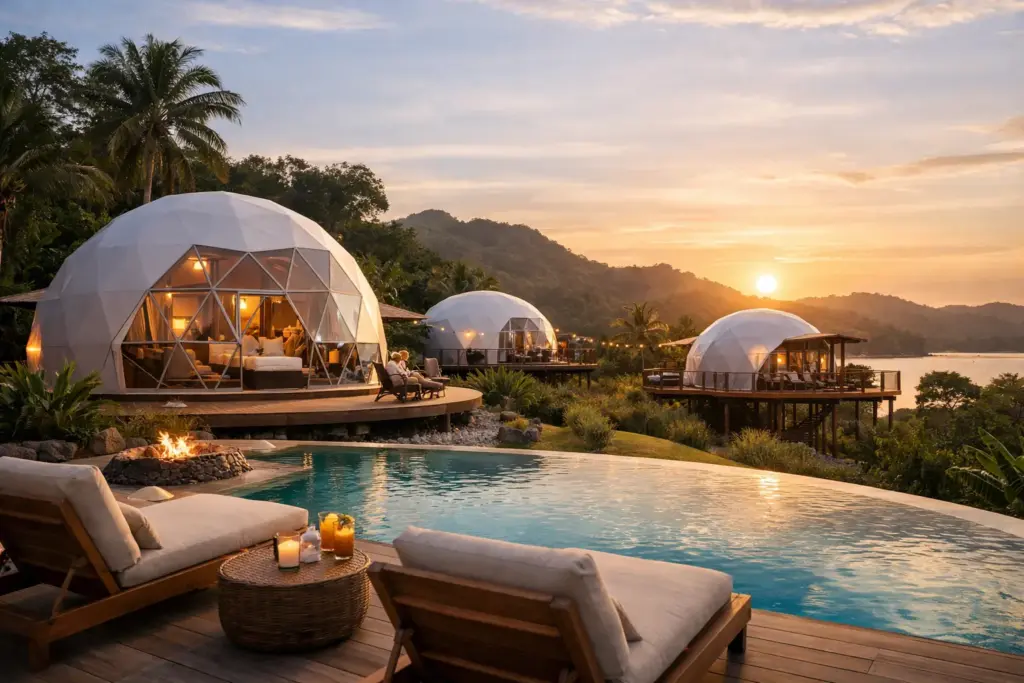
A remarkable overnight stay is no longer a bonus for outdoor hospitality guests. It is often the reason they book. A dome resort gives operators a distinctive way to turn open land, forest edges, waterfront views, and mountain settings into premium accommodations that feel both private and connected to the landscape.
For resort owners and land developers, the appeal goes well beyond the visual impact of a panoramic dome. The right structure can expand lodging inventory with less site disruption than conventional construction, create a higher-value guest experience, and support a business model built for year-round demand. The opportunity is not simply to place unique accommodations on a property. It is to create a destination guests remember, recommend, and return to.
What Makes a Dome Resort a Strong Hospitality Asset
A dome resort brings together the emotional pull of nature and the expectations of modern hospitality. Guests can watch rain move through the trees, wake to a mountain view, or spend an evening beneath the stars without sacrificing a comfortable bed, private bathroom, climate control, or thoughtful finishes. That contrast is what makes the experience marketable.
For an operator, a geodesic dome offers advantages that matter long after opening day. Its form is inherently efficient, with a strong structural design that can be engineered for demanding weather conditions. Insulation, weatherproof materials, and energy-conscious systems help support use beyond a short seasonal window. This matters in markets where a property must perform in winter, shoulder seasons, or changing weather to achieve its revenue goals.
The dome itself is not the business. It is the foundation for a well-positioned hospitality product. A carefully designed unit can serve as a luxury suite, a couples retreat, a family glamping accommodation, a wellness studio, a private dining space, or an event lounge. That flexibility allows owners to build an experience around their land, rather than forcing the property into a standard hotel model.
Design a Dome Resort Around the Guest Journey
The most successful dome resorts feel intentional from the moment a guest arrives. A beautiful structure alone will draw attention, but the complete guest journey determines whether it earns premium rates and lasting reviews.
Start with privacy and orientation. Panoramic windows and transparent ceiling panels are powerful features when they frame a view guests cannot get elsewhere. They are less compelling when they look directly into a parking area or neighboring unit. Use natural contours, trees, elevation changes, pathways, and thoughtful spacing to give each accommodation its own sense of sanctuary.
Arrival also deserves more attention than many new operators give it. Guests should understand where to park, how to reach their dome, and what makes the setting special without feeling as if they are navigating an unfinished property. Soft path lighting, clear wayfinding, luggage-friendly access, and a welcoming exterior zone create confidence before guests even step inside.
The interior should justify the nightly rate
Inside, the dome should feel considered rather than crowded. A premium stay requires more than attractive furniture. It needs a comfortable sleeping area, a place to sit and take in the view, practical storage, dependable heating and cooling, and lighting that shifts naturally from daytime function to evening atmosphere.
The most effective layouts use the dome’s open volume as an advantage. A bed oriented toward a view, layered textiles, warm wood tones, and carefully selected finishes can make the space feel elevated without competing with the landscape. Where plumbing and local regulations allow, private bathrooms and shower facilities can significantly broaden the property’s audience and pricing potential.
Outdoor amenities can create another level of value. A private deck, fire feature, sauna, cold plunge, outdoor shower, or soaking tub gives guests a reason to spend more time on-site. The right choice depends on climate, operating capacity, local rules, and the profile of the guest you want to attract. Not every unit needs every amenity, but each one should have a clear purpose in the guest experience.
Build for Operations, Not Just Opening Weekend
A dome resort can look extraordinary in photographs and still become difficult to manage if operational planning is an afterthought. The strongest projects consider service access, housekeeping, utilities, maintenance, safety, and seasonal conditions early in the design process.
A modular dome structure can reduce the disruption associated with large-scale building projects, particularly on environmentally sensitive or remote sites. However, site preparation still matters. Owners should evaluate drainage, access roads, utility connections, grading, snow loads, wind exposure, local permitting, and fire safety requirements before finalizing the layout. The goal is to preserve the natural character of the property while ensuring the operation is reliable behind the scenes.
Utility planning deserves special care. A remote setting may call for a phased approach to power, water, wastewater, and connectivity. In some cases, the first few units can establish demand before a larger infrastructure investment is made. In others, building utilities for future capacity from the beginning may be more cost-effective. The right answer depends on site conditions and the long-term scale of the business.
Housekeeping and maintenance routes should be discreet but practical. Staff need a simple way to refresh units, transport linens, manage waste, and respond to guest needs without crossing private guest areas at every turn. This is one reason a master site plan is valuable even when launching with only a handful of domes.
Scale the Experience at the Right Pace
One of the strongest commercial advantages of a dome resort is its potential for phased growth. Instead of committing immediately to a large conventional lodging build, an owner can begin with a focused collection of premium units, refine the guest experience, and expand as occupancy and demand support the next phase.
A smaller launch can also reveal what guests value most. A property near a wine region may find that couples packages and private wellness amenities drive bookings. A mountain site may see strong demand for all-season adventure stays. A venue with expansive grounds may discover that event guests create the most valuable demand for overnight accommodations. Those insights can guide future unit sizes, amenity investments, and seasonal offers.
Expansion should still be planned with discipline. Adding domes simply because there is available land can dilute privacy and strain infrastructure. Each additional unit should support the property’s positioning, protect the guest experience, and improve the economics of staffing, utilities, and shared amenities.
StarWild Domes helps hospitality operators approach this opportunity with both design ambition and practical clarity, offering premium structures suited to projects that need durability, all-season performance, and room to grow.
Where Luxury Meets Nature, Revenue Follows
A dome resort can command attention in a crowded lodging market because it offers something conventional rooms cannot replicate: a direct relationship with the setting. That distinction has real commercial value when it is supported by exceptional comfort, clear positioning, and dependable operations.
Premium pricing is most sustainable when the experience solves a guest desire. For some travelers, that means a romantic escape with privacy and a dramatic view. For others, it is a wellness stay that feels removed from daily routines. Group and event guests may value the ability to gather in a setting that feels more memorable than a traditional venue. Your marketing, amenities, and room mix should reflect the strongest demand driver for your location.
Seasonality is another important consideration. A summer-only glamping concept may work well in a high-demand destination, but year-round structures can create more resilient revenue in markets with attractive fall, winter, and spring experiences. Insulation, climate systems, and weather-resistant materials are not merely construction details. They influence booking windows, operating costs, guest comfort, and the confidence to sell a stay in every season.
The best projects also resist the urge to overpromise. Transparent panels can create extraordinary stargazing moments, but they require thoughtful solutions for shade, privacy, cleaning, and temperature management. Remote locations offer seclusion, yet guests may still expect reliable access, communication, and safety. Luxury is often found in how well these practical details disappear from the guest’s mind.
A successful dome resort begins by asking a precise question: what kind of stay can this land offer that guests cannot find anywhere else? Build the answer into every view, pathway, material choice, and operational decision, and the property can become more than a place to sleep. It can become the reason guests choose the destination in the first place.