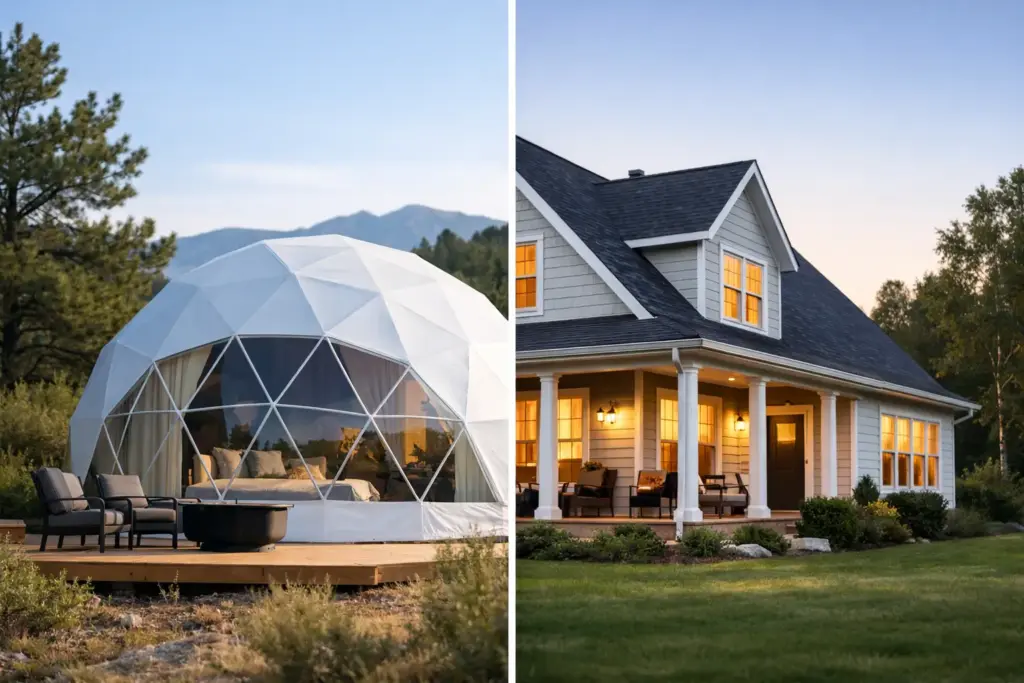
A new guest suite does not have to begin with months of excavation, drawn-out subcontractor schedules, and a footprint that permanently reshapes the land. In the conversation around dome lodging vs traditional construction, that distinction matters because hospitality investors are not just building shelter. They are building demand, nightly rate potential, and a guest experience that stands apart in a crowded market.
For resort owners, retreat operators, and landowners developing revenue-generating accommodations, the real question is not which format feels more familiar. It is which approach aligns with your timeline, brand positioning, operational model, and long-term return. Traditional buildings still have a place, especially in certain zoning environments or for large central facilities. But when the goal is to add premium outdoor lodging with speed, flexibility, and experiential value, dome structures deserve a serious look.
Dome lodging vs traditional construction: what changes for operators?
The difference begins with the nature of the asset itself. Traditional construction is often designed as a permanent, site-intensive building process. It usually involves larger foundations, more trades, longer build sequences, and more moving parts before the first guest checks in. That can make sense for a main lodge, restaurant, or large-scale infrastructure project.
Dome lodging follows a different logic. It is modular, design-forward, and often easier to deploy with less site disruption. For hospitality operators, that changes the economics and the pace of development. Instead of waiting through a lengthy build cycle for a conventional cabin or suite, you can create premium inventory faster and in a format guests immediately perceive as distinctive.
This is where business strategy enters the conversation. Guests rarely book outdoor hospitality based on square footage alone. They book for privacy, atmosphere, views, and the feeling that the stay is worth talking about. A well-positioned dome can deliver all four while also helping an operator expand inventory in phases rather than committing to a fully built-out project from day one.
Speed to revenue matters more than most projects admit
One of the clearest advantages of dome lodging vs traditional construction is deployment speed. In hospitality, delays have a direct cost. Every postponed opening means lost occupancy, lost event bookings, and a longer runway before the asset begins producing income.
Traditional construction often carries a wider range of timing risks. Weather delays, labor shortages, permit sequencing, material availability, and coordination issues can all stretch timelines. Even well-managed projects can slow down once site work starts.
With dome structures, the process is generally more efficient. Modular systems, simplified installation, and lower site disturbance can reduce the time between concept and operation. That does not mean every project is instant or permit-free. Local regulations still matter, and site readiness still matters. But for operators who want to move decisively, domes often create a more practical path to launch.
That speed matters even more for seasonal destinations. If you miss a high-demand booking window in a mountain, desert, lakeside, or wellness market, you are not simply pushing revenue back by a few weeks. You may be delaying meaningful income by an entire season.
Guest appeal is not a soft factor – it is pricing power
Traditional accommodations can be beautiful, but many standard cabins and small guest units struggle to feel differentiated unless the operator invests heavily in custom design. Dome lodging starts from a more memorable place. The architectural form, panoramic setting, and immersive connection to the outdoors create instant visual identity.
That identity translates into stronger marketing performance and premium positioning. Guests notice a dome in listing photos. They remember it. They share it. For operators, that can mean stronger direct interest, higher perceived value, and more room to command premium nightly rates.
This is especially relevant in competitive outdoor hospitality markets where travelers are no longer looking for basic shelter. They want design, comfort, and a sense of escape. Dome accommodations support that expectation with a format that feels elevated rather than improvised.
There is a practical side to this as well. A structure that creates emotional appeal can outperform a conventional one even if the construction cost is not dramatically lower. Revenue is shaped by guest demand, not just project budget. If one accommodation type consistently photographs better, books better, and earns stronger reviews, it may produce better long-term value.
Site impact and land use can shape the entire project
For landowners and developers, the condition of the site is not a minor detail. It affects permitting, budget, construction complexity, and brand identity. Traditional construction often requires more invasive preparation, more heavy equipment activity, and a more fixed relationship with the landscape.
Dome lodging tends to work better for projects that want to preserve the natural character of the property. Reduced site disruption can be a major advantage for wooded settings, view-driven sites, wellness retreats, and environmentally conscious hospitality concepts. The lighter touch is not only operationally helpful. It also supports the story many operators want to tell about immersion in nature.
This can be a meaningful difference when you are building a luxury outdoor experience rather than a conventional lodging block. Guests are often paying for the feeling of being placed carefully within the landscape, not on top of it.
Cost is more nuanced than the sticker price
It is easy to compare dome lodging and traditional construction by focusing only on initial build cost, but that approach misses the bigger financial picture. The better comparison looks at total project value, speed to market, operating efficiency, and revenue potential.
Traditional construction can carry higher costs through site work, labor intensity, longer timelines, and design complexity. It may also require a larger commitment upfront, especially if the project is being built at full scale from the beginning.
Dome lodging offers a different financial profile. Depending on the model, site conditions, and interior finish level, domes can help reduce build complexity while opening faster paths to monetization. They also support phased expansion. An operator can start with a smaller number of units, validate demand, refine the guest experience, and scale with more confidence.
That flexibility is valuable. It lowers the pressure to get every future assumption right on day one. Instead of overbuilding, you can grow in response to booking performance and market traction.
Dome lodging vs traditional construction for year-round use
A common misconception is that dome structures are only suited for seasonal or novelty stays. That may be true of lower-grade products, but it is not true of premium, purpose-built hospitality domes designed for all-season performance.
For serious operators, year-round usability is essential. Insulation, weather resistance, energy efficiency, and interior comfort all influence occupancy and operating margins. A well-designed dome can support four-season hospitality while maintaining the visual appeal that makes it attractive in the first place.
Traditional construction still has an advantage in some extreme-use scenarios, particularly when the project requires highly customized internal systems or very large enclosed spaces. But for guest accommodations, wellness suites, and experiential lodging units, modern dome systems can be both durable and commercially viable across a wide range of climates.
That is where supplier quality matters. Not all domes are equal, and not all hospitality projects need the same specification. Operators should evaluate structural performance, insulation strategy, weatherproofing, and support services with the same discipline they would apply to any lodging investment.
Scalability changes how you build the business
Traditional construction often encourages a single, large project mindset. You plan extensively, invest heavily, and wait for the full result to come online. That can work, but it can also create long lead times and greater capital exposure.
Dome lodging supports a more agile growth model. You can launch with a limited number of units, establish rate integrity, test guest demand, and then expand. For operators building a glamping resort, private retreat venue, or outdoor wellness concept, that scalability is more than a convenience. It is a strategic advantage.
It also creates room for diversification. A property might begin with lodging domes and later add a spa dome, yoga space, event structure, or dining experience. The result is a hospitality environment that evolves with the business rather than forcing every decision into the first construction phase.
This is one reason premium suppliers such as StarWild Domes appeal to operators thinking beyond a single structure. The value is not just in the dome itself. It is in the ability to create a high-end accommodation model that can expand with demand.
When traditional construction still makes sense
There are cases where traditional construction remains the right choice. If you are developing a primary lodge with back-of-house operations, commercial kitchen infrastructure, or highly specific architectural requirements, a conventional building may be more appropriate. The same applies in some jurisdictions where local code, financing structures, or permitting frameworks clearly favor traditional methods.
This does not have to be an either-or decision. Many of the strongest hospitality projects combine both approaches. A central traditional facility can anchor the property, while dome lodging adds premium guest inventory with stronger experiential appeal and faster expansion potential.
That hybrid model often delivers the best of both worlds – permanence where you need it, flexibility where it helps, and a guest offering that feels elevated rather than generic.
The smartest projects are rarely the ones that follow habit. They are the ones that match the build strategy to the business model. If your goal is to create distinctive outdoor accommodations with premium appeal, scalable growth, and a faster path to revenue, dome lodging is not an alternative to take lightly. It may be the format that lets the land perform at its highest value.