
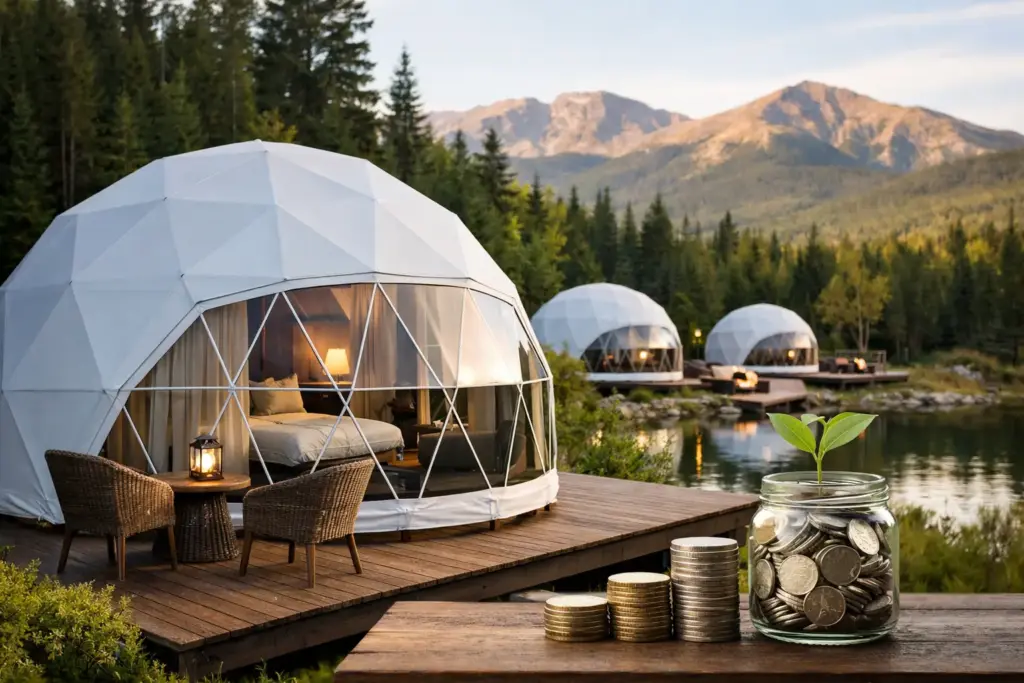
A well-placed dome can change the economics of a property faster than many owners expect. When operators ask, are glamping domes profitable?” the real question is not whether a dome can generate revenue. It is whether the concept, pricing, site, and guest experience are aligned well enough to produce healthy margins and pay back capital in a reasonable timeframe.
For many resorts, retreat operators, and landowners, the answer is yes. Glamping domes can be highly profitable because they combine premium nightly rates with comparatively efficient deployment, low site disruption, and strong guest appeal. But profitability is not automatic. It depends on how the dome is positioned, how often it books, what it costs to run, and whether the experience feels elevated enough to justify the rate.
Are glamping domes profitable in real hospitality terms?
They can be, especially when they are treated as revenue-generating hospitality assets rather than novelty structures. The strongest-performing dome projects usually sit at the intersection of three forces: demand for distinctive stays, the ability to command a premium rate, and a cost structure that stays disciplined over time.
Guests are no longer only booking a room. They are booking atmosphere, privacy, views, and a story worth sharing. A dome gives operators a design-forward accommodation type that feels immersive and memorable without requiring the footprint, construction timeline, or rigidity of a traditional building. That difference matters because perceived value often outpaces square footage.
In practical terms, a dome can outperform conventional lodging on a revenue-per-square-foot basis when the guest experience is thoughtfully designed. Panoramic views, a private deck, a hot tub, a skylight panel, or a wellness-focused interior can all support higher rates. That premium positioning is where profitability begins.
What drives dome profitability
Nightly rate is the most visible factor, but it is only one part of the picture. Occupancy, season length, operating costs, financing, and guest acquisition all shape the return.
A dome in a high-demand destination with year-round usability may achieve strong occupancy at rates that materially exceed nearby standard cabins or hotel rooms. If the property offers privacy, natural beauty, or an experience tied to wellness, romance, or adventure, that pricing power can increase further. The dome becomes part accommodation, part attraction.
Seasonality also matters. Operators in colder climates often assume demand disappears in winter, yet insulated, weather-ready domes can extend the booking calendar significantly. That can transform a seasonal business into a longer operating season, which has a direct effect on annual revenue and payback timelines.
Operating discipline matters just as much as topline revenue. Utilities, cleaning, maintenance, booking fees, staffing, insurance, and guest amenities all affect margins. A dome that is easy to clean, energy efficient, and built for harsh weather conditions will generally protect profitability better over time than a lower-cost structure that creates recurring operational headaches.
Revenue potential depends on the market you serve
Not every dome should be priced the same way, and not every market supports the same returns. A luxury resort adding domes as premium inventory will approach profitability differently than a landowner launching a two-unit retreat.
In an upscale hospitality setting, the dome often works best as a premium category. It can attract couples, wellness travelers, and celebration-based bookings willing to pay more for privacy and design. In that context, the dome is not competing with a budget cabin. It is competing with boutique suites and distinctive experiential lodging.
For retreat operators, domes can also perform beyond overnight stays. They may support wellness sessions, private dining, spa treatments, or event programming. That layered revenue model can improve profitability because the structure contributes to more than sleeping capacity.
Venue developers may find domes especially useful when they create flexibility. A dome can serve as accommodation, a bridal suite, a meditation space, or a seasonal lounge depending on the property concept. When one structure supports multiple revenue paths, ROI can become more attractive.
The cost side of the equation
The reason many investors look seriously at domes is that they can expand lodging inventory without the full burden of conventional construction. That does not mean they are inexpensive. Premium domes are a capital investment, and serious operators should evaluate them that way.
The upfront cost typically includes the structure itself, site preparation, foundation or platform work, utilities, interior fit-out, furnishings, bathrooms, climate control, and any guest-facing upgrades that support premium pricing. These can add up quickly, particularly when the goal is a luxury-standard guest experience.
Still, compared with building permanent structures from the ground up, domes often offer advantages in speed, reduced site disruption, and modular expansion. Those advantages are not just operational conveniences. They can shorten the timeline to revenue, reduce development complexity, and allow operators to test a market with less rigidity.
That flexibility has strategic value. If a property proves demand with one or two domes, it can scale in phases rather than overcommitting all at once. For many owners, that staged growth model is part of what makes the business case appealing.
How long does it take for a dome to pay for itself?
There is no universal payback period, because variables differ widely by market and operating model. Still, many successful projects target a return profile based on occupancy, average daily rate, and all-in project cost rather than relying on general industry averages.
A dome with a strong location, premium design, year-round usability, and effective marketing may recover its investment much faster than a project with lower rates, limited seasonality, or weak guest positioning. That is why broad claims about profitability can be misleading. Two dome projects can look similar on paper and perform very differently in practice.
Owners should model realistic occupancy instead of best-case occupancy. They should also test whether the rate they want to charge is genuinely supported by the experience. If the finish level, amenities, and setting feel exceptional, premium pricing is easier to sustain. If the offering feels unfinished, profitability can erode quickly through discounting.
What separates profitable dome projects from struggling ones
The most profitable dome businesses usually do a few things exceptionally well. They choose a location with real demand, create a guest experience that feels distinctly elevated, and build operational systems that keep service quality high without letting costs drift.
Design plays a bigger role than many first-time operators assume. Guests pay for the emotional impact of the stay. A dome with thoughtful interiors, strong climate comfort, beautiful lighting, and an intentional connection to the landscape will generally outperform a dome that feels temporary or underdeveloped.
Experience design matters too. Privacy, check-in simplicity, outdoor bathing, fire pits, curated packages, and photo-worthy details all support rate integrity. In outdoor hospitality, the memory often drives the margin.
Operational resilience is another dividing line. Domes intended for commercial use should be durable, weather-ready, and practical to maintain. Hospitality assets that look beautiful in photos but create constant upkeep issues can eat into profit faster than expected. This is where a premium supplier with commercial understanding can make a meaningful difference.
Are glamping domes profitable enough to scale?
Often, yes, if the first units are planned with expansion in mind. Scalability is one of the clearest commercial advantages of the dome model. Once an operator validates demand, adds guest feedback, and refines pricing, additional units can build on an existing concept rather than starting from zero.
That kind of phased growth is attractive to resort owners and land developers because it reduces risk. It allows capital to follow performance. A modular approach can also preserve the landscape and maintain the sense of exclusivity that makes glamping valuable in the first place.
For operators with multi-unit ambitions, consistency becomes critical. The design language, housekeeping process, utility planning, and guest journey all need to work across the property. A dome business scales best when it is not just selling structures but a repeatable premium stay experience.
The honest answer for investors and owners
So, are glamping domes profitable? Yes, they can be very profitable, especially for operators who understand that demand is created by more than shelter. It is created by setting, design, comfort, and the ability to offer something guests cannot find in a standard room.
The trade-off is that profitability depends on execution. A dome in the wrong market, with weak positioning or average amenities, may underperform. A well-designed dome with all-season capability, strong visual appeal, and disciplined operations can become one of the most productive assets on a property.
That is why the smartest way to evaluate a dome is not as a trend, but as a hospitality product. When luxury meets nature in a way guests are eager to book and share, the business case becomes much stronger.
For property owners looking to build their business without committing to traditional development paths, a glamping dome is often more than an accommodation unit. It is a flexible, design-led way to create revenue from land that might otherwise stay underused.