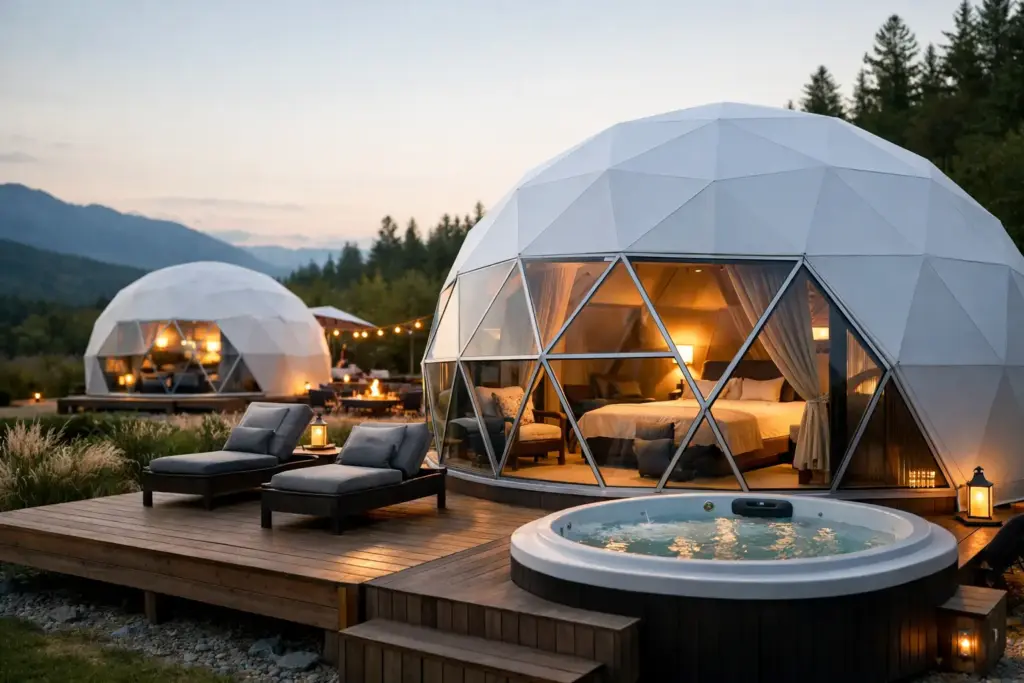
A standard cabin can give guests a place to sleep. Retreat dome accommodations give them a reason to book, photograph, remember, and recommend the stay.
That difference matters more than ever for retreat operators, resort owners, and landowners entering outdoor hospitality. Guests are no longer choosing based on square footage alone. They are choosing atmosphere, privacy, design, and the feeling of being close to nature without giving up comfort. For operators, that shift creates a clear opportunity: build inventory that feels premium, performs efficiently, and supports stronger nightly rates.
Why retreat dome accommodations stand out
The appeal starts with the experience itself. A dome does not read like a conventional room dropped into a natural setting. It feels intentional. The curved architecture, panoramic views, and optional transparent ceiling features create a sense of immersion that traditional structures often struggle to match.
For wellness retreats, couples’ getaways, boutique resorts, and destination venues, that emotional response has commercial value. Guests are willing to pay more for accommodations that feel distinctive. They also tend to share them more often, which extends your marketing reach beyond paid campaigns.
This is where retreat dome accommodations become more than a design choice. They function as a brand asset. They help a property position itself as elevated, modern, and experience-led – not just another lodging option competing on price.
The business case behind premium dome lodging
Beautiful accommodations are only useful if they also make sense operationally. That is why serious buyers tend to ask a different set of questions after the first visual impression. How quickly can this be installed? How much site work is required? Can it handle four-season use? Does it support expansion later?
Dome structures answer those questions in ways that traditional construction often cannot. Compared with building permanent cabins or guest suites from the ground up, domes can reduce complexity, shorten deployment timelines, and limit disruption to the land. For properties that want to generate revenue sooner, that speed matters.
They also give operators more flexibility. A single dome can launch a concept. A small cluster can test demand. A larger rollout can scale a successful hospitality model across a property without forcing a one-shot development decision at the beginning.
That flexibility is especially valuable in retreat settings, where demand can evolve by season, guest segment, and programming style. A wellness operator may begin with private sleeping domes and later add a spa dome, yoga dome, or communal dining dome. An event venue may introduce overnight lodging first, then expand into bridal suites or VIP hospitality spaces once occupancy patterns are proven.
Guest expectations are higher than ever
Nature alone is not enough to command premium pricing. Guests want the setting, but they also want climate control, insulation, quiet interiors, thoughtful lighting, and finishes that feel curated rather than improvised.
This is where lower-quality structures often fail. If a dome looks beautiful in photos but feels too hot in summer, too cold in winter, or too temporary during a storm, the guest experience suffers quickly. That leads to weaker reviews, lower return rates, and pricing pressure.
Well-designed dome accommodations perform differently. Durable materials, energy-efficient construction, weather resistance, and proper insulation support year-round use and a more dependable guest experience. For operators in the US and Canada, this is not a luxury detail. It is part of protecting occupancy across changing climates and shoulder seasons.
The strongest retreat properties understand that premium design and operational practicality are not competing goals. They are part of the same business model.
What to look for in retreat dome accommodations
Not all domes are built for hospitality, and not all hospitality projects need the same configuration. The right solution depends on your land, guest profile, climate, and growth plan.
A retreat operator focused on high-end wellness may prioritize privacy, acoustics, spa-like interiors, and a visual connection to the landscape. A resort owner may care more about repeatable unit layouts, efficient servicing, and expansion across multiple pads. A venue developer may want structures that serve both lodging and event functions.
That said, a few qualities consistently matter.
Four-season performance
If your revenue plan depends on more than peak summer demand, the structure must support real all-season use. Insulation, weatherproofing, and energy efficiency affect both guest comfort and operating costs. In colder regions, this becomes central to profitability, not an afterthought.
Premium visual impact
A dome should feel elevated from the moment guests arrive. The architecture itself is part of the product. Panoramic forms and transparent viewing elements can help create the kind of memorable stay that supports premium positioning and organic demand.
Efficient installation
Traditional construction can be slow, invasive, and difficult to phase. Dome systems with modular or turnkey installation paths allow owners to activate land faster and with less site disruption. For many operators, that shorter path to opening can materially improve project economics.
Scalability
A hospitality concept rarely stays static. You may add units, reconfigure guest flow, or expand programming over time. Structures that support phased growth give you room to build your business with more control.
Relocation flexibility
Some sites evolve. Some concepts pivot. Some operators start with a pilot before committing to a broader buildout. Domes that can be redeployed or repositioned offer strategic flexibility that fixed construction does not.
Retreat dome accommodations and ROI potential
The strongest return usually comes from a combination of factors rather than a single one. Distinctive design can support stronger nightly rates. Faster deployment can accelerate revenue generation. Lower site disruption can reduce development friction. Four-season usability can broaden the booking calendar.
Taken together, those advantages can create a compelling investment case.
Of course, ROI depends on the market and operating model. A luxury couples retreat in a scenic destination may lean heavily on premium ADR. A corporate retreat venue may gain value from multipurpose use across lodging and meeting space. A landowner launching a first hospitality concept may focus on minimizing upfront complexity while testing demand.
That is why the dome itself should not be evaluated in isolation. It should be evaluated as part of the guest journey, the land plan, and the revenue model.
Where dome accommodations fit best
Some hospitality concepts are especially well suited to this format. Wellness retreats benefit from the quiet, private, sanctuary-like atmosphere. Boutique resorts gain an accommodation type that differentiates the property immediately. Event venues can add overnight inventory without building a conventional hotel product. Destination properties can create a stronger sense of place while preserving connection to the landscape.
There is also a practical advantage for operators working with beautiful but sensitive land. Minimal-disruption installation can help preserve the character of the site, which is often the very thing guests are paying to experience.
This balance – luxury meets nature without the burden of heavy traditional construction – is a large part of why domes have become such a compelling category in outdoor hospitality.
Choosing a partner, not just a structure
A dome supplier should do more than deliver a shell. Commercial hospitality projects need a partner that understands guest expectations, climate realities, site conditions, and growth planning.
That matters because the cheapest path is not always the most economical one. A lower-cost structure that underperforms in insulation, durability, or installation efficiency can create more expense later through maintenance, poor reviews, limited seasonal use, or lost pricing power.
By contrast, premium suppliers such as StarWild Domes are designed around the needs of serious operators: elegant design, weather-ready performance, modular deployment, and scalable options that support long-term business growth.
For buyers in the evaluation stage, the smartest question is not simply, “How much does the dome cost?” It is, “What kind of hospitality asset does this create over time?”
The real opportunity
Retreat dome accommodations work best when they are treated as part of a larger vision. They are not there to imitate traditional lodging. They are there to give your property a signature experience, a faster path to market, and a more compelling reason for guests to choose you.
For operators who want to build a premium outdoor hospitality business, that combination is hard to ignore. The most successful properties in this space are not chasing novelty for its own sake. They are creating places people want to return to – and assets that are built to perform.