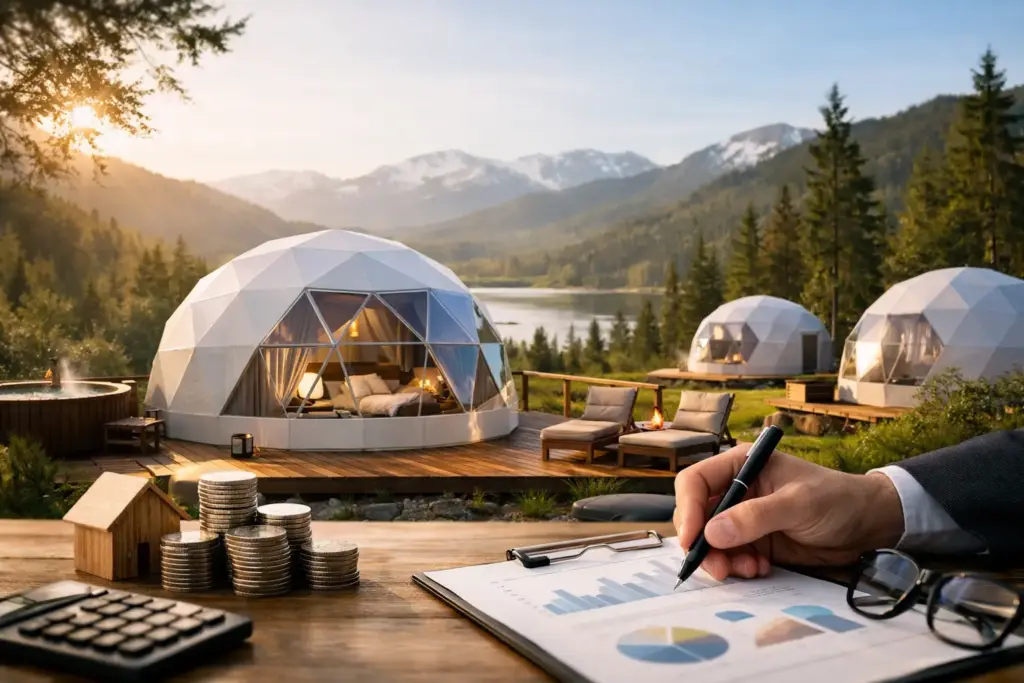
A well-placed dome can start earning long before a traditional cabin ever breaks ground. That is why glamping dome resort investment has become a serious consideration for resort owners, land developers, and hospitality entrepreneurs who want to expand inventory without taking on the full cost, delay, and disruption of conventional construction.
The appeal is easy to understand. Guests are paying more for memorable stays, not just square footage. They want privacy, comfort, design, and a stronger connection to the landscape. For operators, that creates an opportunity to build your business with accommodations that feel distinctive enough to command premium nightly rates while remaining practical to install, scale, and operate.
Why glamping dome resort investment is gaining attention
Outdoor hospitality has matured. What once felt niche now sits firmly inside the broader travel market, especially for properties serving couples, wellness travelers, event guests, and urban escape seekers. A dome resort answers a demand pattern that standard hotel inventory often cannot – immersive lodging with a sense of occasion.
That matters because pricing power usually follows differentiation. If your property offers an experience guests can find anywhere, rate growth becomes difficult. If it offers panoramic architecture, carefully framed views, and year-round comfort in a setting that feels rare, guests tend to compare it less to a budget hotel and more to a premium getaway.
From an investment standpoint, domes also appeal because they shorten the path from concept to revenue. Traditional builds often involve longer construction schedules, more invasive site work, and more layers of complexity. A modular dome approach can reduce friction, particularly for owners who want to test demand, launch in phases, or expand accommodation inventory without overbuilding too early.
What makes a dome a compelling hospitality asset
Not every lodging unit creates the same commercial value. The best-performing hospitality assets do two things at once – they attract attention in the market, and they make operational sense after opening. Domes can do both when specified correctly.
The guest-facing value is obvious. Their shape, natural light, and panoramic presence turn a room into part of the destination. Optional transparent roof panels, elevated interiors, and thoughtful placement create the kind of stay guests photograph, share, and remember. That helps marketing before a guest arrives and supports stronger review performance after the stay.
The operating value is just as important. A premium dome built for commercial use can be insulated, weatherproof, and energy efficient enough for all-season use in many climates. That changes the math. A seasonal unit may look attractive on paper, but a longer booking window often gives an operator far more flexibility in cash flow, staffing, and return planning.
There is also the question of site impact. For many landowners and resort developers, preserving the landscape is not only a brand decision but a practical one. Minimal site disruption and easier installation can help maintain the character of the property while reducing the burden associated with heavy construction.
The numbers behind glamping dome resort investment
A smart buyer does not ask whether domes are attractive. The real question is whether the revenue model supports the capital outlay.
That answer depends on rate strategy, occupancy, season length, operating costs, and the broader strength of the property concept. A luxury dome on exceptional land with the right amenities can produce strong revenue per available unit because it blends premium positioning with a relatively efficient path to deployment. But the dome itself is only part of the equation. Site planning, guest experience, utilities, access, and pricing discipline all shape performance.
In general, investors tend to evaluate dome projects through a few practical lenses. First is speed to market. If a dome can begin generating revenue faster than a comparable conventional build, the investment case improves quickly. The second is average daily rate. If the design and experience support a meaningful rate premium, the return profile strengthens. Third is scalability. A concept that works with two units and can grow to eight or twelve without redesigning the whole operation often has more strategic value.
This is where many projects either gain momentum or lose it. A glamping concept with beautiful design but weak operating logic can struggle. By contrast, a resort model that combines luxury positioning with standardized deployment, efficient housekeeping flow, durable materials, and year-round usability often becomes much easier to finance and grow.
Site selection can make or break returns
The strongest dome resorts are not always built on the most dramatic land. They are built on land that matches the business model.
Views matter, but access matters too. A property close enough to a metro area for short-stay demand may outperform a more remote site with better scenery but weaker occupancy. Topography, drainage, climate exposure, utility planning, and local permitting conditions all affect both launch costs and long-term margins.
There is also a branding question. Some properties are ideal for romantic escapes. Others are better suited for wellness retreats, family lodging, or event-driven stays. The more clearly the site supports a specific type of guest demand, the easier it becomes to shape the right dome mix, amenity package, and pricing model.
Investors should also think beyond the first phase. Can the property expand without compromising privacy? Will additional units improve profitability, or will they dilute the guest experience that justifies premium rates? A scalable resort plan is not simply about adding more structures. It is about preserving the conditions that made the first units desirable.
Where investors often get the model wrong
The biggest mistake is treating a dome like a tent with better design. Premium guests do not pay top rates for novelty alone. They pay for comfort, privacy, climate control, quality bathrooms, refined interiors, and the feeling that nature and luxury have been thoughtfully brought together.
Another common misstep is underestimating infrastructure. Domes may be easier to deploy than traditional buildings, but a profitable resort still depends on power, water strategy, wastewater solutions, circulation paths, guest arrival flow, and service logistics. The glamour of the concept should never distract from the fundamentals of hospitality operations.
Some investors also overbuild too soon. It can be smarter to launch with a smaller number of high-performing units, prove rate and occupancy, refine the guest journey, and then scale. Phased growth protects capital and allows the property to evolve from real guest behavior rather than assumptions.
This is why supplier quality matters. In commercial hospitality, a lower upfront cost can become expensive very quickly if the structure underperforms in weather, insulation, durability, or maintenance demands. A premium dome should not only look exceptional in marketing photos. It should also support reliable operations over time.
How to evaluate a glamping dome resort investment opportunity
A serious evaluation starts with one question: can this property support premium demand consistently, not just during peak weekends? If the answer is yes, the next step is to test the concept against practical realities.
Look at the revenue side first. What nightly rate is realistic for your market, your audience, and your level of finish? How many nights can the property reasonably sell across seasons? Will your guest mix support direct bookings, packages, retreats, or event spillover demand? A dome resort works best when the experience is distinct enough to rise above price comparison.
Then assess the cost structure with discipline. Consider not just the structure cost but also installation, site preparation, infrastructure, furnishings, staffing, utilities, insurance, maintenance, and marketing. The most attractive projects are rarely the cheapest to launch. They are the ones where the total investment creates a product the market is willing to pay for repeatedly.
It is also worth evaluating resilience. Can the structure perform across weather shifts? Can the resort maintain guest comfort without excessive energy use? Can the property adapt over time by adding units, repositioning inventory, or introducing new experiences? Flexibility has real value in hospitality because demand evolves.
For many operators, this is where a partner like StarWild Domes enters the conversation. The right dome supplier does more than provide a structure. They help shape an accommodation asset that balances luxury appeal with practical deployment, commercial durability, and room for growth.
The long-term value proposition
A strong dome resort is not just a lodging addition. It can reshape how a property competes. It gives landowners and hospitality developers a way to create high-impact accommodations with a lighter footprint, a faster path to launch, and a guest experience built around memory rather than standardization.
That does not mean every site is a fit, or that every operator will see the same returns. Market positioning, operating discipline, and execution still decide the outcome. But for investors who understand premium outdoor hospitality, glamping domes offer a compelling middle ground between ambition and practicality.
The real opportunity is not simply to add rooms. It is to create a place guests actively seek out, return to, and recommend – a place where luxury meets nature and every unit works harder for the business behind it.
If you are evaluating land, demand, and expansion strategy, start there: not with how many domes you can place, but with how thoughtfully each one can earn its place on the property.