
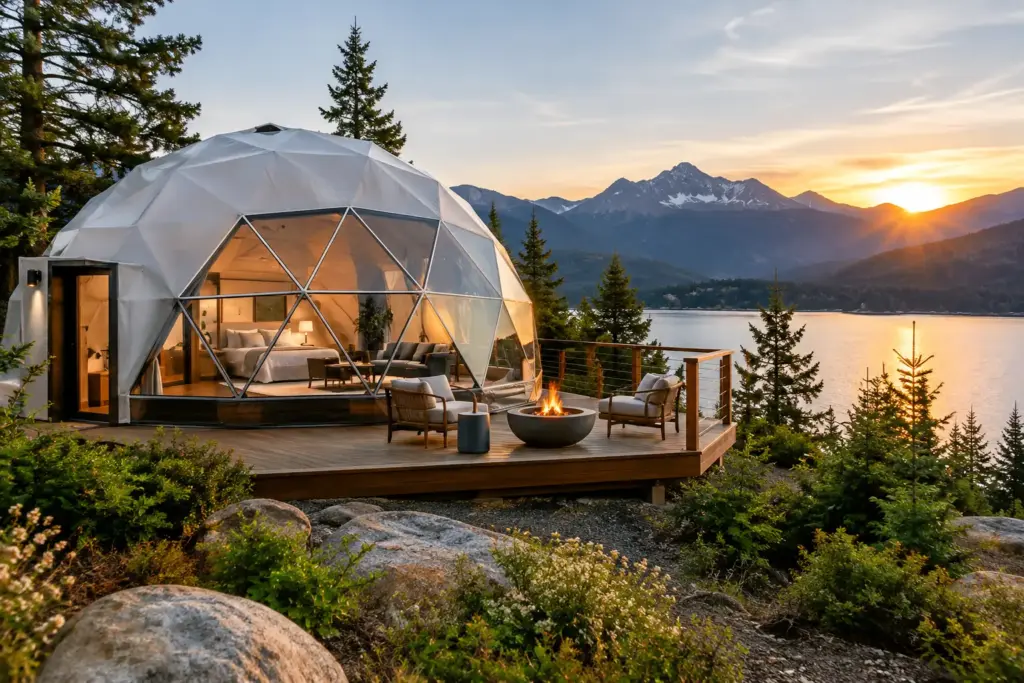
A remarkable dome experience begins long before guests arrive. It begins with the moment they turn off the main road, see the landscape open ahead of them, and feel they have entered somewhere intentionally set apart. The right parcel can elevate a luxury dome into a sought-after retreat. The wrong placement can introduce avoidable costs, operational friction, and guest complaints. This dome site selection guide is designed to help hospitality owners choose a location that supports both an exceptional stay and a strong business model.
Start With the Guest Journey, Not the Empty Acreage
A wide-open field may look simple to build on, but the best dome site is rarely the most obvious flat area on a property. Consider the guest experience from arrival through checkout. Where will guests park? Can they reach the dome comfortably in rain, snow, or after dark? Does the walk or drive to the unit create anticipation, privacy, and a sense of arrival?
Premium outdoor hospitality depends on thoughtful separation. Guests want immersion in nature, but they also expect convenience. A dome positioned too far from parking may complicate luggage handling, housekeeping, maintenance, and accessibility. One placed too close to a service road, neighboring cabin, or event area may lose the quiet seclusion that supports premium nightly rates.
Look for a site that creates a natural sequence: clear arrival, discreet parking, a beautiful approach, and a private outdoor zone. Even a modest walk can feel intentional when the path is stable, well-lit, and framed by the landscape.
The Dome Site Selection Guide for Views and Privacy
A panoramic view is one of the strongest commercial assets a dome can offer. Forest canopies, mountain ridges, water, meadowland, and dramatic skies all create a reason for guests to book, photograph, and return. Yet a view should be evaluated from inside the structure, not only from a standing position on the land.
Spend time at the proposed site at different hours. Morning sun, late-afternoon glare, seasonal foliage, nearby lights, and neighboring activity can all change the experience. A west-facing outlook may deliver extraordinary sunsets, but it can also increase heat gain during warmer months. A wooded location may feel deeply private in summer while becoming more exposed once leaves fall.
Privacy is equally valuable. If guests can see directly into another accommodation, a parking area, or a neighboring property, the perceived luxury of the stay declines. Thoughtful orientation, existing vegetation, landscape screening, and spacing between units can protect privacy without sacrificing the view.
For multi-unit projects, avoid arranging every dome in a straight line along the same sightline. A staggered layout that follows the terrain usually feels more natural, provides better visual separation, and allows each unit to claim its own sense of place.
Confirm Access Before You Commit
Site access affects construction budgets, ongoing operations, emergency planning, and the guest experience. Before selecting a location, confirm that installers, delivery vehicles, maintenance teams, and emergency services can reach it safely. Narrow gates, steep grades, low tree branches, soft ground, sharp turns, and seasonal road conditions deserve early attention.
This does not mean every dome must sit beside a paved road. One advantage of modular dome structures is their ability to bring high-end accommodations to locations where conventional construction would be more disruptive or expensive. Still, practical access matters. A site that requires extensive road upgrades, major tree removal, or complicated equipment mobilization may reduce the financial advantage of a lighter-footprint build.
Assess access in the conditions your property will actually face. A dry summer inspection does not reveal what happens during spring thaw, heavy rainfall, or winter snowfall. In northern climates, reliable all-season access can be central to protecting occupancy and preserving a year-round revenue strategy.
Study the Ground, Drainage, and Grade
The land beneath the dome deserves as much attention as the scenery around it. A suitable site needs stable ground, effective drainage, and a foundation approach appropriate for local conditions. Water should move away from the accommodation, pathways, and outdoor living areas rather than collect around them.
Slightly elevated sites often perform well because they naturally shed water and can offer broader views. However, excessive slope may increase site-preparation costs and complicate access. The ideal balance depends on the property, local soils, foundation design, and the experience you intend to create.
Avoid placing domes in low-lying pockets where cold air settles, water accumulates, or snowmelt lingers. These areas can feel damp and uncomfortable, particularly during shoulder seasons. They may also demand more drainage work and create recurring maintenance concerns.
A professional site assessment can clarify soil conditions, drainage patterns, flood risk, and any grading required before installation. This step may feel preliminary, but it is far less expensive than correcting water or foundation issues after launch.
Plan Utilities as an Operating System
Luxury is not only about the view through a panoramic window. It is also dependable heat, hot water, lighting, Wi-Fi, climate control, and an uncomplicated guest stay. Utilities should be considered early because their distance from the proposed dome site can significantly affect project cost.
Electricity, water, wastewater, and communications all require a practical plan. A location near existing utility corridors may reduce trenching and infrastructure expenses, but proximity should not override privacy or scenery. The goal is to find a commercially sensible balance between a remarkable setting and manageable utility runs.
For off-grid or low-impact concepts, define performance expectations clearly. Solar, battery storage, propane, septic systems, and water storage can support compelling remote stays, but they must be sized for real guest behavior and local weather. A luxury retreat cannot depend on guests limiting showers, avoiding climate control, or troubleshooting power systems.
Think beyond opening day. Housekeeping needs water access. Winter operations may require freeze protection. Guests expect reliable connectivity, particularly when a retreat appeals to remote workers, couples planning longer stays, or corporate groups.
Review Zoning, Permits, and Site Constraints Early
A beautiful site is only an asset if it can be legally and practically used for hospitality. Before investing heavily in design or infrastructure, review zoning, land-use rules, building requirements, septic regulations, fire access, setback requirements, and short-term rental policies.
Requirements vary widely across jurisdictions in the United States and Canada. Some areas welcome tourism development; others have strict rules around overnight accommodations, event use, utility connections, or protected land. If your concept includes multiple domes, wellness facilities, weddings, or retreat programming, review the entire intended operation rather than permitting one unit in isolation.
Environmental constraints also matter. Wetlands, floodplains, protected habitats, shoreline setbacks, and wildfire-prone zones may shape where and how you build. These considerations do not always stop a project, but they can affect site layout, construction timing, insurance, and long-term operating costs.
Early conversations with local planning professionals, engineers, and permitting authorities can protect the schedule and help you make decisions with confidence. For an investment property, clarity is a form of risk management.
Design for All-Season Comfort
The most profitable location is not necessarily the warmest or easiest one. A snowy forest, windswept ridge, or cool lakeside setting can be highly marketable when the structure and site plan are designed for the climate. The key is to understand what the site asks of the accommodation.
Consider prevailing winds, snow loads, sun exposure, shade, humidity, and wildfire conditions. In colder regions, orienting and insulating the dome for efficient heating can support winter stays while lowering operating demands. In warmer locations, shade, ventilation, and strategic orientation help maintain comfort without excessive energy use.
Outdoor amenities deserve the same climate awareness. A hot tub deck, fire feature, private patio, or outdoor shower should feel protected rather than exposed. The setting should invite guests outside, not make them battle wind, mud, insects, or poor lighting.
Premium dome structures from StarWild Domes are designed to support durable, energy-efficient, year-round hospitality concepts. But even the best structure performs more beautifully when it is placed with respect for the climate, terrain, and operational realities of the property.
Build for Expansion Without Sacrificing Character
A single dome can validate demand. A carefully planned site can support a scalable hospitality business. When selecting the first location, look beyond the first unit. Where could future domes sit without compromising privacy? Can utility systems expand? Is there room for a reception point, wellness space, event pavilion, staff storage, or additional parking if the concept grows?
Expansion should not make the property feel crowded. The strongest glamping destinations use spacing, landscape, and circulation to preserve a sense of discovery. Each new accommodation should add revenue while protecting the feeling that every guest has found their own private sanctuary.
Choose a site that does more than fit a dome. Choose one that gives guests a story worth sharing, gives your team a practical operation to run, and gives your business room to grow with intention.