
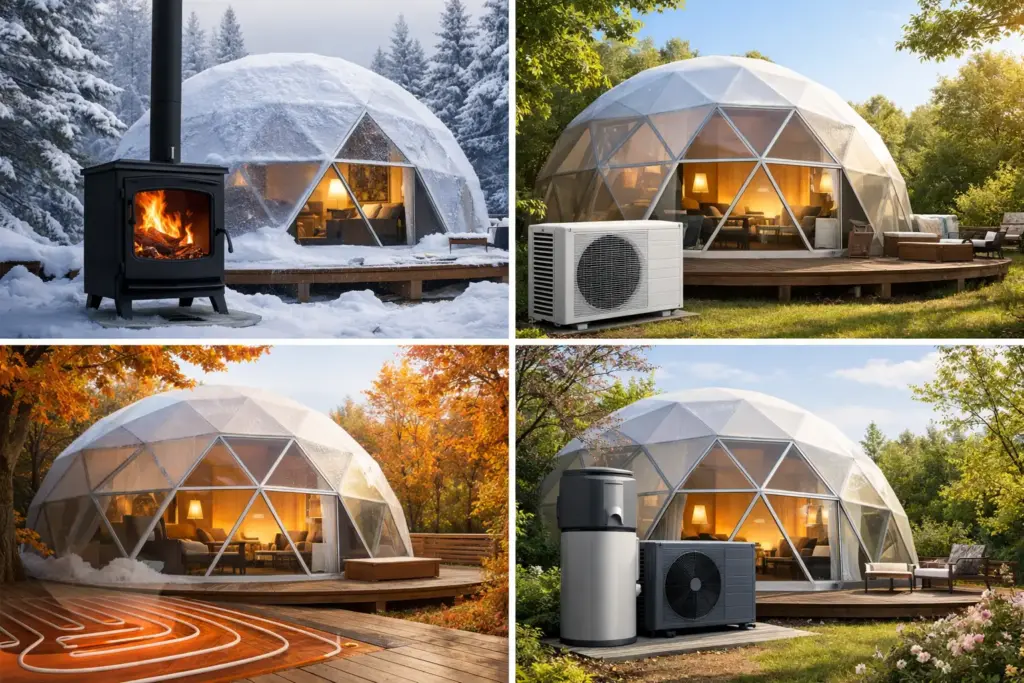
A dome can look extraordinary through a winter storm, but a breathtaking view does not compensate for cold floors, uneven temperatures, or a noisy heater cycling through the night. For operators building premium outdoor stays, choosing the best heating systems for domes is a guest-experience decision first and an operating-cost decision close behind.
The right approach depends on your climate, insulation package, utility access, operating season, and the level of comfort your nightly rate promises. A well-designed dome should feel like a private sanctuary in January as much as it does in July. Heating needs to support that standard without overwhelming the space, compromising the panoramic design, or creating a maintenance burden across a growing portfolio.
Why domes need a different heating strategy
A geodesic dome does not behave like a conventional cabin. Its curved envelope can distribute air efficiently, but warm air naturally rises into the upper portion of the structure. Without thoughtful air circulation and insulation, the guest area may feel cooler than the thermostat suggests.
Surface area, entry-door use, window placement, transparent ceiling panels, and the local design temperature all affect heat loss. A dome in the Blue Ridge Mountains faces a different challenge than one in Arizona, while a lakefront property with frequent wind requires more attention to air sealing than a sheltered woodland site.
This is why heating equipment should never be selected by square footage alone. A qualified HVAC professional should calculate the heating load using the dome’s actual insulation values, glazing, location, elevation, and planned occupancy. That calculation protects both comfort and capital: oversized equipment can short-cycle, waste energy, and create temperature swings, while undersized equipment leaves guests disappointed on the coldest nights.
The best heating systems for domes
For most upscale glamping and retreat applications, a cold-climate ductless mini-split is the strongest all-around option. It provides efficient electric heating, adds air conditioning for summer operations, and preserves valuable interior space. The indoor head can be positioned to circulate air across the living zone, while the outdoor unit keeps mechanical equipment out of sight.
Ductless mini-splits for year-round flexibility
A high-quality cold-climate mini-split is especially compelling for operators in areas with moderate to cold winters. Modern units can continue producing useful heat at low outdoor temperatures, although capacity and efficiency decline as conditions become more severe. In the coldest markets, pairing the mini-split with a secondary heat source offers greater confidence during extreme weather.
The commercial advantage is clear: one system supports four-season booking potential. Guests enjoy quiet, controllable comfort, and operators avoid installing separate heating and cooling equipment. Mini-splits also suit modular hospitality projects because each dome can have independent climate control, simplifying phased expansion and reducing the consequences of a single equipment failure.
There are trade-offs. Outdoor units need clearances, a stable mounting location, and protection from snow accumulation or drifting. Proper condensate management matters, particularly where freeze-thaw cycles are common. A low-cost unit may appear attractive at installation, but reliability, low-temperature performance, local service support, and warranty terms deserve more weight in a revenue-generating accommodation.
Radiant floor heating for an elevated guest experience
Radiant floor heating delivers a distinctly luxurious kind of comfort. Rather than primarily warming the air, it warms the floor surface and the people in the room. Guests notice it immediately when stepping out of bed on a winter morning, making it particularly well suited to wellness retreats, high-end resort domes, and properties that command premium rates.
Electric radiant mats can be practical for smaller domes or targeted zones such as bathrooms and entry areas. Hydronic radiant systems, which circulate warm water through tubing, can be highly efficient at a larger scale when connected to an appropriate boiler or central plant. They are often most compelling when several units are being developed at once.
Radiant heat does require early planning. It is easiest to incorporate during the foundation and flooring design stage, and it responds more slowly than a forced-air system when guests change the thermostat. For many hospitality projects, the most refined solution is radiant flooring for baseline comfort paired with a mini-split for fast temperature adjustment, cooling, and air movement.
Direct-vent gas heat for cold-weather resilience
A direct-vent propane or natural-gas heater can be an effective primary or backup option where winter conditions are demanding and electrical capacity is limited. These systems provide strong, immediate heat and can continue operating during an outage if paired with the appropriate ignition and power configuration. Propane is often the more realistic choice for remote properties without natural gas service.
For a dome, direct venting is essential. Combustion appliances must be correctly installed, vented, and permitted to protect indoor air quality and guest safety. Carbon monoxide detectors are non-negotiable, as are routine inspections and clear operating procedures for housekeeping and maintenance teams.
Gas heat can carry higher fuel price volatility and more ongoing service requirements than a heat pump. It also does not solve summer cooling. Still, it is a sensible resilience layer for remote, high-elevation, or northern sites where a dependable backup source protects occupancy during the periods when every booked night matters most.
Electric wall heaters and infrared panels for targeted warmth
Electric resistance heaters, including wall-mounted units, baseboards, and infrared panels, are simple to install and useful in select applications. They are often best used as supplemental heat rather than the sole source for a premium lodging dome.
Infrared panels can create comfortable warmth in a bathroom, reading nook, or seating area without occupying much floor space. Electric wall heaters can provide a reliable emergency backup for a mini-split. Their limitation is operating cost: resistance heat turns electricity directly into heat, while a heat pump can move multiple units of heat for each unit of electricity consumed.
For properties with relatively low electricity rates, modest winter use, or a need for straightforward room-by-room redundancy, these systems remain practical. They are less attractive as the only heating strategy for a high-occupancy, cold-climate operation.
Build the envelope before buying more heat
The least expensive heat is the heat your dome does not lose. Insulation, air sealing, insulated flooring, and well-designed doors have as much influence on comfort as the heater itself. Before adding capacity, examine the full thermal envelope.
Pay close attention to the base platform, which is frequently the coldest surface in a dome. An insulated floor assembly can improve comfort dramatically and reduce the temptation to oversize the HVAC system. Seal penetrations around utilities, verify door weatherstripping, and consider insulated window coverings where large transparent areas face prevailing winter winds.
Transparent ceiling panels are a signature feature for many luxury dome experiences, but they require thoughtful planning in both winter and summer. The right glazing specification, shading strategy, and orientation can help manage solar gain. In a sunny cold climate, daytime solar warmth may reduce heating demand. In a shoulder season, that same gain can cause overheating unless the cooling and ventilation plan is ready.
A quiet ceiling fan is another small but meaningful addition. Running it at a low speed in the proper direction helps bring warm air down from the dome’s upper volume without creating an uncomfortable draft. It is one of the simplest ways to improve temperature consistency.
Choose a system around your operating model
The ideal heating plan changes with the way your property earns revenue. A single private retreat that closes during severe weather can prioritize simplicity and lower upfront cost. A destination resort advertising year-round luxury needs redundancy, remote monitoring, and rapid recovery between guest stays.
Ask practical questions early. Will the dome remain heated between bookings? Is the site served by adequate electrical power, or will upgrades be needed? Can your team access outdoor equipment during snow or heavy rain? What happens if the primary system fails on a holiday weekend? These answers matter as much as the equipment specification.
For many operators, the most balanced package is a cold-climate mini-split, an insulated floor assembly, a ceiling fan, and a modest backup heat source. Add radiant flooring when the guest experience and project budget justify it. In severe climates or remote locations, consider direct-vent gas backup as part of a resilience plan.
StarWild Domes projects are designed around the reality that year-round hospitality requires more than a beautiful shell. When the structure, foundation, mechanical plan, and guest experience are considered together, comfort becomes part of the property’s value proposition rather than a recurring operational concern.
The best heating investment is the one guests never have to think about: they arrive from the cold, set down their bags, and immediately feel that the space has been prepared for them.