
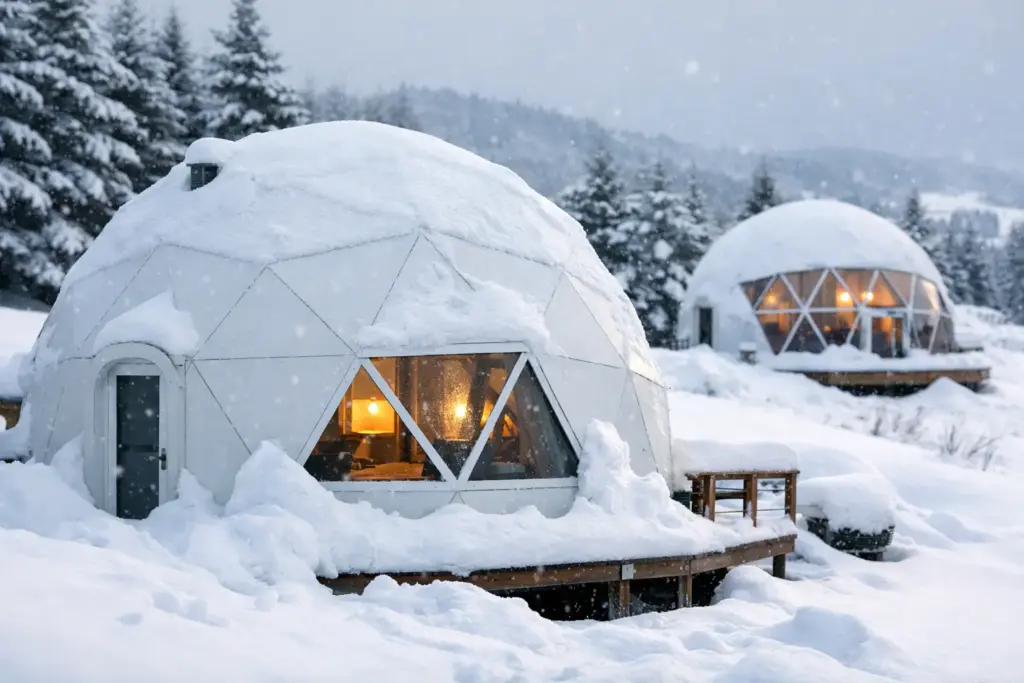
A winter booking calendar looks very different when guests are waking up beneath a quiet snowfall instead of staring at an empty off-season property. That is why one of the first questions serious operators ask is simple: can domes handle snow? The short answer is yes – when they are properly engineered, correctly installed, and matched to the realities of the site.
For resort owners, retreat developers, and landowners evaluating year-round outdoor hospitality, snow performance is not a side question. It affects safety, season length, operating costs, guest confidence, and ultimately revenue potential. A dome that performs well in winter does more than survive the weather. It helps turn a beautiful location into a dependable business asset.
Can domes handle snow in real winter conditions?
They can, but not all domes are built to the same standard. Snow performance depends on engineering, frame strength, cover materials, insulation strategy, foundation design, and how the dome is positioned on the land. A premium geodesic dome has natural structural advantages because its shape distributes loads efficiently across the frame. That geometry is one reason domes are often chosen for demanding climates.
Even so, the phrase “snow-capable” should never be treated as a blanket claim. A light seasonal dome for occasional use is not the same as a commercial-grade structure intended for year-round hospitality in northern markets. For operators in the U.S. and Canada, the real question is less “Can domes handle snow?” and more “Which dome specification is appropriate for my snowfall, elevation, and business model?”
That distinction matters. In hospitality, underbuilding costs more than building correctly the first time.
Why dome shape works well under snow load
Traditional roof systems often concentrate weight across a smaller number of structural points. A geodesic dome spreads force through a triangulated frame, which gives it excellent strength relative to its material weight. In practical terms, that means snow loads are managed through the structure rather than borne by a few vulnerable spans.
The curved profile also helps. Snow does not always accumulate on a dome the way it does on a conventional roof with flatter sections or valleys. Depending on temperature, snow type, wind, and roof surface conditions, some snow may shed more naturally. That can reduce buildup, though it should never be assumed that a dome will remain completely clear on its own.
This is where nuance matters. Wet, heavy snow behaves differently than light powder. Freeze-thaw cycles can create ice. Wind exposure changes drifting patterns. The dome shape is a major advantage, but performance still depends on the full system, not geometry alone.
Engineering matters more than appearance
From a guest perspective, a dome delivers drama, comfort, and a strong sense of place. From an ownership perspective, the invisible details are just as important. If you are planning a snow-region installation, the engineering package should be taken as seriously as the design concept.
A dome intended for winter hospitality should be evaluated for structural load requirements specific to the site. That includes expected snow load, local building code considerations, wind exposure, and foundation conditions. Frame materials, connection points, anchoring systems, and membrane quality all contribute to how the structure performs under stress.
This is why commercial buyers should be cautious about comparing domes on looks alone. Two dome products may appear similar in photos and behave very differently in January. For a revenue-generating property, aesthetics matter. Structural credibility matters more.
Snow load is only part of winter performance
Many buyers focus on whether a dome can physically hold snow. That is essential, but it is not the whole picture. In hospitality, winter performance also means maintaining interior comfort, controlling condensation, protecting finishes, and managing energy use.
A well-insulated dome can support a warm, stable guest environment even when outside temperatures drop. That improves the guest experience and helps protect your operation from the reputational damage that comes with cold, drafty, underperforming accommodations. Winter guests may forgive weather. They do not forgive discomfort.
Good insulation, quality sealing, and thoughtful climate control also help reduce issues that can be amplified in cold conditions, such as moisture buildup on interior surfaces. In a premium lodging environment, winter readiness is both a structural and an operational standard.
Site planning can make or break snow performance
The same dome can perform very differently depending on where and how it is installed. That is especially true in snowy regions.
Placement affects wind exposure, drifting, solar gain, drainage, and ease of winter access. A dome tucked into a sheltered position may experience different snow behavior than one installed on an exposed ridge. Orientation can influence how much sun the structure receives, which can affect surface snow melt and interior heating efficiency. Ground conditions and elevation also shape foundation needs.
For hospitality operators, access is equally important. Snow removal planning should cover paths, decks, guest circulation, utility routes, and service access. A high-performing dome loses value quickly if staff cannot reach it safely or guests struggle to use the site in winter conditions.
This is one reason premium dome projects are most successful when the structure is treated as part of a complete operating environment, not a stand-alone product dropped onto land.
What owners should ask before buying
If winter use is part of your revenue plan, the buying conversation should move beyond broad claims. Ask for the snow load capacity relevant to your intended location. Ask how insulation is configured for cold-weather occupancy. Ask what foundation and anchoring approach is recommended for your site. Ask what maintenance expectations apply during snow season.
You should also ask a more strategic question: what kind of winter business are you building? A dome used occasionally on private land has one set of requirements. A dome intended to host paying guests all season, protect brand standards, and support premium nightly rates has another.
For operators, that difference is everything. Snow capability is not only about avoiding failure. It is about preserving uptime, protecting guest satisfaction, and sustaining strong ROI potential through more of the calendar year.
The business case for snow-capable domes
When a dome is designed for all-season performance, snow country can become an advantage rather than a limitation. Winter landscapes are highly marketable. Snowfall creates atmosphere, privacy, and a sense of escape that many travelers will pay a premium to experience. For retreat properties and resorts, that can extend demand well beyond summer and shoulder season.
A dome that supports reliable winter operations can help build your business in several ways. It can diversify occupancy, strengthen average daily rate in peak winter travel windows, and differentiate your property from conventional lodging stock. It also opens creative programming opportunities, from wellness retreats to romantic stays to event-driven seasonal experiences.
This is where the right dome structure becomes more than an accommodation unit. It becomes an income-producing asset that aligns design appeal with operational practicality.
At StarWild Domes, that balance is central to the value proposition: premium design that feels elevated to the guest, paired with structural durability and all-season thinking that makes sense for the operator.
Can domes handle snow better than many expect?
Yes, and that is often the surprise. People may associate domes with novelty, but commercial-grade geodesic domes are serious structures. When specified correctly, they can perform impressively in cold, snowy environments while still delivering the panoramic experience guests remember and share.
Still, there are trade-offs. Extreme snow regions may require higher engineering thresholds, more active site management, and greater attention to insulation and utilities. Transparent panels, deck layouts, and custom design features may also affect how a dome behaves in winter and should be considered carefully. Premium hospitality does not mean ignoring the climate. It means designing beautifully with the climate in mind.
That is the difference between a dome that looks good in a brochure and one that supports a dependable four-season business.
If snow is part of your landscape, it does not have to be a reason to hesitate. It can be part of the appeal – provided the structure, the site, and the operating plan are built with the same level of intention as the guest experience.