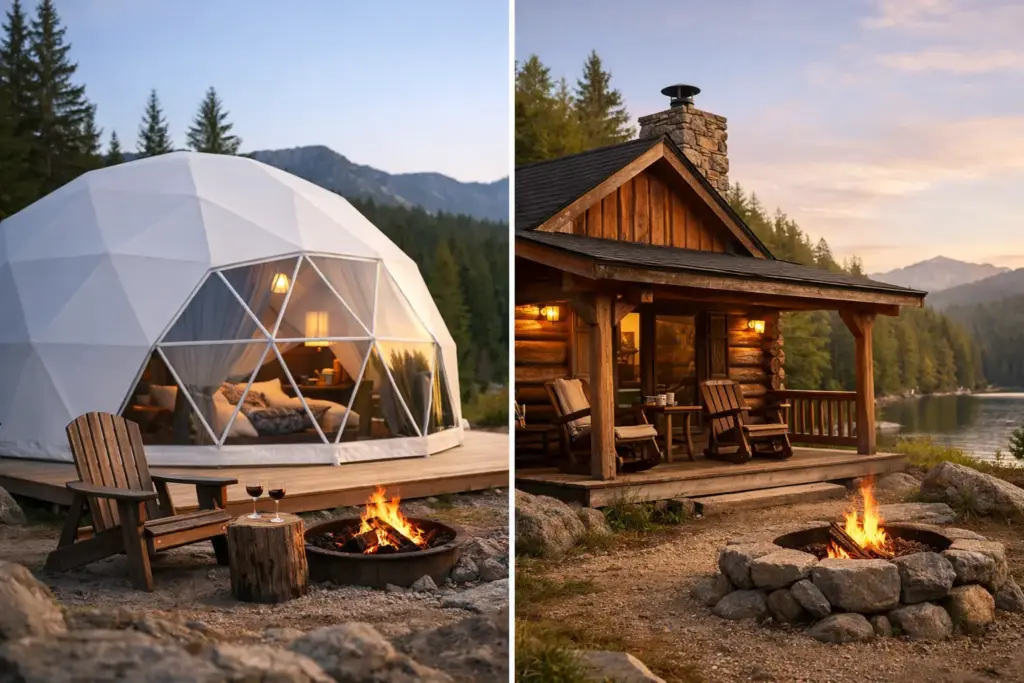
A guest scrolls past a standard cabin listing in seconds. A panoramic dome under the trees makes them stop. That is the real starting point in the glamping domes vs. cabins decision – not just what you want to build, but what kind of stay people will notice, remember, and pay more to book.
For resort owners, retreat operators, and landowners building revenue-generating accommodations, the choice is rarely about aesthetics alone. It is about guest demand, speed to market, site impact, year-round performance, operating efficiency, and long-term brand value. Both domes and cabins can work. The better investment depends on what experience you are selling and how quickly you want that experience to begin producing returns.
Glamping domes vs cabins: the core difference
Cabins are familiar. They signal comfort, privacy, and a traditional outdoor stay. For some properties, that familiarity is an advantage. Guests understand what they are booking, and lenders, partners, or local stakeholders may feel more comfortable with a structure that looks conventional.
Domes offer something different. They create a visual identity on day one and position a property closer to premium experiential hospitality than standard lodging. The curved form, expansive interior feel, and opportunity for panoramic views turn the accommodation itself into part of the attraction. That matters in a market where guests are not only booking a place to sleep – they are booking a story, a setting, and a reason to share their stay.
If your goal is to blend into a crowded market, cabins are workable. If your goal is to stand apart and command stronger nightly rates, domes often create more immediate differentiation.
Guest appeal and pricing power
In most outdoor hospitality markets, uniqueness drives attention. Attention drives clicks. Clicks drive bookings. This is where domes often outperform cabins.
A well-designed dome feels immersive and elevated at the same time. Guests can wake up under filtered morning light, look out across the landscape, and feel connected to nature without sacrificing comfort. Transparent panels and open sightlines create a sense of luxury that is difficult to replicate in a conventional cabin layout.
Cabins can absolutely feel upscale, especially with strong design and premium finishes. But they usually need more interior styling, more square footage, or a more elaborate site plan to create the same sense of distinction. A cabin may be charming. A dome is often the reason someone chooses your property over another.
That difference can influence pricing power. Experiential stays tend to support premium positioning because guests are paying for emotional value as well as function. When the structure itself becomes part of the destination, the accommodation works harder for your brand.
Speed to launch and development complexity
For many operators, the most expensive delay is time. Every month spent in extended construction, permitting complexity, or site disruption is a month without revenue.
Cabins often involve a more traditional building path. Depending on size, design, and local jurisdiction, that can mean more extensive foundations, longer construction timelines, larger crews, and more coordination across trades. On some sites, especially remote or environmentally sensitive ones, that process can become costly fast.
Domes are attractive because they support a more agile development model. Modular deployment, simplified installation, and reduced site disturbance can help operators activate land faster. That matters whether you are testing a new hospitality concept, adding inventory to an existing resort, or scaling across multiple units.
This is not to say domes are exempt from planning or local requirements. They are not. But for operators focused on speed, flexibility, and phased growth, domes often align better with a modern outdoor hospitality strategy than fixed, conventional builds.
Site impact and placement flexibility
Land is rarely uniform. You may have wooded acreage, uneven terrain, scenic overlooks, meadows, or underused sections of a larger hospitality property. The structure you choose needs to work with the land, not force the land into an expensive redesign.
Cabins typically ask more of the site. Access, excavation, and permanent construction needs can narrow placement options and increase prep work. That can limit how creatively you use your best views or most private areas.
Domes tend to be more adaptable. Their lighter footprint and modular nature can reduce disruption and open up locations that might be less practical for cabin construction. For operators who want to preserve the natural character of the property while still creating premium stays, that flexibility is more than a design advantage – it is a business advantage.
It also supports phased expansion. You can start with a small number of units, validate demand, and add more inventory over time without redesigning the entire property around a rigid building approach.
Year-round use and operating performance
One of the biggest misconceptions in outdoor hospitality is that unique structures are only suitable for fair-weather seasons. That may be true for low-spec glamping products. It is not true for high-quality domes built for commercial use.
A premium dome designed with insulation, weather resistance, and energy efficiency can support all-season operations across a wide range of North American climates. That changes the financial picture significantly. Seasonal products can generate buzz. A year-round product can build a business.
Cabins also perform well in four-season markets, and in colder regions they have a long track record. But the question is not whether cabins can operate year-round. It is whether they provide the same combination of climate performance, visual appeal, and installation efficiency.
For operators balancing guest comfort with utility costs, quality matters on either side. A poorly built cabin becomes expensive to maintain. A poorly specified dome can underperform. The real comparison is between commodity structures and premium hospitality assets. In that category, domes can compete strongly on both experience and operations.
Maintenance, durability, and long-term management
Cabins can feel familiar from a maintenance standpoint because many operators already understand wood-frame upkeep. But familiarity does not always mean simplicity. Exterior wood, roofing, pest exposure, moisture management, and ongoing repairs can become an accumulating burden, especially across multiple units.
Domes shift that equation. Commercial-grade materials, weatherproof construction, and a simplified exterior form can reduce some of the maintenance variables that come with traditional structures. For owners managing dispersed accommodations or lean operational teams, fewer maintenance surprises support healthier margins.
That said, durability depends on product quality and supplier capability. A dome built for hospitality use is very different from a recreational or temporary structure. Serious operators should evaluate lifespan, insulation package, climate suitability, support services, and replacement planning before making a decision.
This is where working with an experienced supplier matters. Companies such as StarWild Domes are positioned around the commercial realities of outdoor hospitality, not just the visual appeal of the structure.
Brand positioning and expansion potential
Cabins fit comfortably into many hospitality brands. They are versatile, recognizable, and often easier to explain to a broad audience. If your property leans rustic, heritage-driven, or highly traditional, cabins may feel aligned.
But if your ambition is to create a more elevated, design-forward identity – where luxury meets nature and the stay itself becomes your marketing engine – domes offer a sharper brand signature. They photograph beautifully, create stronger first impressions, and support the kind of premium storytelling that performs well across booking platforms and social channels.
They also scale elegantly. A cluster of domes can feel curated rather than repetitive. For operators planning retreats, wellness stays, private escapes, or event-linked lodging, that design language can be extended across the property in a way that feels intentional and high value.
Which option delivers better ROI?
This is the question behind all the others. In a straight glamping domes vs. cabins comparison, ROI depends on your market, land, positioning, and operating model.
If you already own a property where traditional cabin accommodations fit the guest expectation, and if construction logistics are straightforward, cabins may offer a stable path. They are proven, familiar, and can perform well over time.
But for many hospitality entrepreneurs and landowners entering or expanding in experiential lodging, domes have a compelling advantage. They can reach market faster, create stronger visual differentiation, support premium nightly rates, and expand with less disruption. That combination often improves the revenue side of the equation while giving operators more flexibility on the development side.
The strongest returns usually come from matching the structure to the brand promise. If your guests are seeking novelty, luxury, nature immersion, and memorable design, domes are often the more strategic asset. If your guests want classic shelter with less emphasis on the experience of the structure itself, cabins may be enough.
The better question is not which is universally better. It is which one helps your property become more bookable, more scalable, and more valuable over time.
A smart outdoor hospitality investment should do more than add rooms. It should sharpen your positioning, elevate the guest experience, and give you room to grow with confidence.