A fixed cabin can take months of planning, permitting, and construction before it ever welcomes a paying guest. In contrast, relocatable hospitality structures give operators a faster, more flexible path to revenue – especially when the goal is to add premium inventory without locking a property into a single long-term layout.
For resort owners, land developers, and retreat operators, that flexibility is not a minor perk. It can shape how you phase expansion, test demand, respond to seasonal shifts, and protect the character of the land itself. When done well, a relocatable structure is not a temporary compromise. It is a strategic hospitality asset.
Why relocatable hospitality structures matter now
Outdoor hospitality has matured. Guests are no longer satisfied with a rustic tent and a nice view if they are paying premium nightly rates. They want comfort, privacy, climate control, thoughtful design, and a stay that feels elevated from arrival to checkout.
At the same time, operators are under pressure to grow intelligently. Traditional construction often brings higher upfront costs, longer timelines, and more site disruption than many projects can absorb. That is especially true for properties with remote access, sensitive landscapes, or a phased investment strategy.
Relocatable hospitality structures sit in a compelling middle ground. They allow owners to introduce refined, design-forward accommodations while preserving optionality. You can start with a limited number of units, validate pricing and occupancy, and expand with more confidence. If your site plan evolves, the structure can move with the business rather than becoming an immovable constraint.
What makes a structure truly relocatable
Not every modular or prefabricated unit is genuinely suited for relocation. In hospitality, relocatability has to work beyond the sales brochure. It must support real operational needs, from installation logistics to long-term durability.
A truly relocatable structure should be designed for efficient assembly and disassembly, with a footprint that minimizes site disturbance and a system that can be redeployed without excessive reconstruction. It also needs to perform like a permanent hospitality space once installed. Guests do not lower their expectations simply because a structure can move.
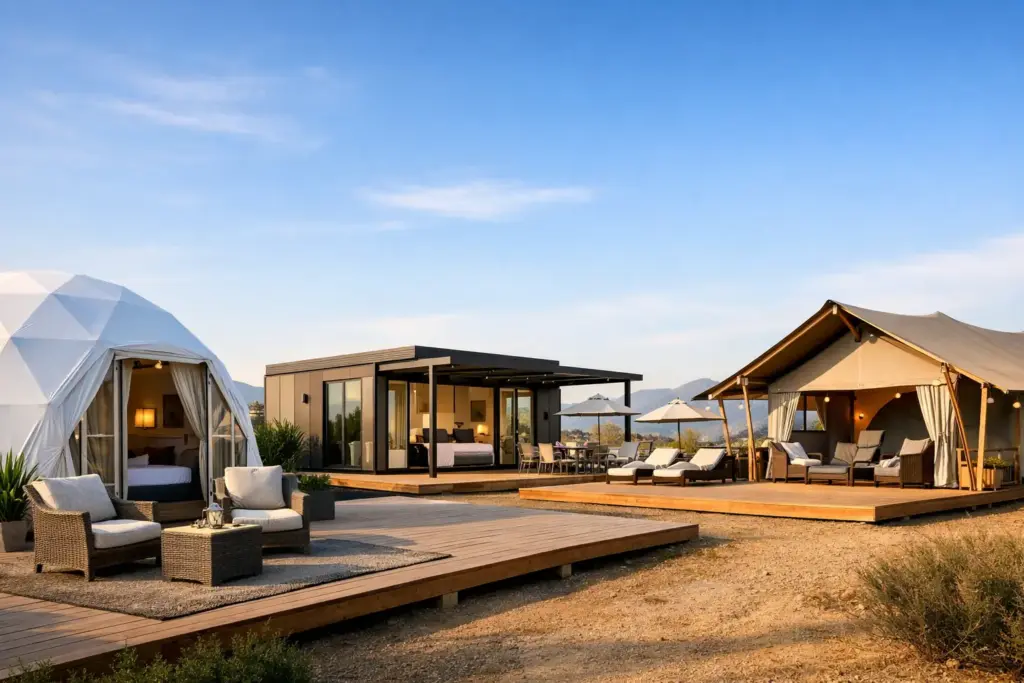
That is where quality matters. Premium dome structures, for example, can combine relocation flexibility with insulated envelopes, weather resistance, panoramic design, and year-round comfort. This combination is what turns relocatability from a technical feature into a business advantage.
The business case for flexibility
In outdoor hospitality, timing matters almost as much as design. A slow build can mean a missed season, delayed cash flow, or a lost opportunity in a market where guest demand is moving quickly.
Relocatable hospitality structures can reduce the friction that often slows projects down. Faster deployment means operators can begin monetizing land sooner. Lower site disruption can also reduce the complexity of preparing a property, particularly where preserving natural topography is part of the guest appeal.
There is also a strong strategic case for phased growth. Rather than overbuilding on day one, operators can launch a smaller cluster of units, monitor booking patterns, refine pricing, and add inventory as demand strengthens. This kind of measured scaling often creates a healthier path to ROI than committing all capital at once.
It is not always the right choice for every property. A large destination resort with a fixed master plan may still prefer some conventional builds in core areas. But for expansion zones, satellite accommodations, event lodging, wellness spaces, or terrain-sensitive sites, relocatable structures can offer a smarter balance of speed and control.
Guest experience still decides the rate you can charge
Operational flexibility is valuable, but guests book on emotion first. They are choosing a setting, a feeling, and a standard of comfort. If the structure feels temporary, the nightly rate will reflect that.
This is why premium design is central to the success of relocatable hospitality. Architecture should frame the landscape, not compete with it. Interiors should feel quiet, private, and intentional. Climate performance should support shoulder seasons and, in many markets, full year-round use.
A geodesic dome is especially effective here because it creates a distinctive sense of place while remaining operationally practical. Its form feels immersive and elevated, yet the system can be installed with less disruption than many traditional buildings. Features such as insulation, weatherproofing, and optional transparent panels add more than visual appeal – they support comfort, occupancy, and the kind of memorable stay that generates repeat business.
For premium operators, that matters. Design is not decoration. It is part of the pricing model.
Where relocatable hospitality structures fit best
The strongest use cases tend to be properties that want to expand without losing agility. A retreat brand may need guest suites now but also want the option to reconfigure the site as programming evolves. A resort may want to test a new adults-only zone before committing to permanent infrastructure. A landowner entering hospitality may want to launch with a contained investment and scale based on proof of demand.
These structures also work well for event-focused venues. Luxury overnight accommodations can increase booking value, extend guest stays, and create a more complete destination experience. For wellness properties, relocatable units can support treatment rooms, meditation spaces, or private lodging without requiring a full conventional buildout at the start.
In each case, the same principle applies. Flexibility only creates value when the guest experience remains premium and the structure performs reliably in the field.
What buyers should evaluate before investing
The decision should go beyond appearance. The right structure has to support both your brand positioning and your operating model.
First, assess climate performance. If you plan to operate in four seasons, insulation, ventilation, weather resistance, and energy efficiency are not optional. They directly affect guest comfort, utility costs, and revenue continuity.
Next, consider installation realities. Access roads, terrain, utilities, and site prep all influence deployment speed and total project cost. A structure may be relocatable in theory but still create friction if the system is not designed for straightforward installation.
Then look at scalability. A single unit may look beautiful in isolation, but your supplier should be able to support a larger rollout with consistency. That includes planning, logistics, and an understanding of hospitality operations rather than just product delivery.
Finally, think about brand fit. Your accommodations are part of your market position. If you want to command premium rates, the structure must feel worthy of that price point from the exterior profile to the interior atmosphere.
This is where an experienced partner matters. Companies such as StarWild Domes understand that a dome is not just a structure on a site. It is a revenue-generating guest environment that has to balance aesthetics, durability, and operational practicality.
The trade-offs are real, but manageable
Relocatable does not mean limitless. Local codes, permitting conditions, utility planning, and land use constraints still need careful attention. In some jurisdictions, the fact that a structure can move does not remove regulatory requirements. Serious operators should plan accordingly.
There are also cases where permanence has its own advantages. If a site is fully stabilized, the layout is fixed for decades, and the development model favors conventional construction, relocation flexibility may be less important. The better question is not whether relocatable is universally better. It is whether flexibility creates meaningful value for your specific property and timeline.
For many outdoor hospitality businesses, it does. Especially when market demand, land planning, and capital deployment all benefit from a more adaptable model.
A smarter way to build your business
The most compelling hospitality properties do more than add rooms. They create places guests remember and assets owners can scale with confidence. Relocatable hospitality structures offer a rare combination of experiential appeal and commercial agility, allowing operators to grow in ways that feel both visionary and grounded.
That combination is why they continue to gain traction across resorts, retreats, event venues, and private land developments. They support a lighter footprint on the land, a faster route to market, and a guest experience that can still feel luxurious, immersive, and distinct.
For property owners who want to expand where luxury meets nature, the question is not simply how to build. It is how to build with enough flexibility to protect the guest experience today while leaving room for a stronger business tomorrow.