A resort owner comparing expansion options usually starts in the same place – square footage, construction timelines, and guest demand. Then the bigger question shows up: are geodesic domes expensive, or are they simply priced differently than traditional structures?
The honest answer is that premium geodesic domes are not the cheapest way to add enclosed space. But for hospitality operators, that is often the wrong comparison. The better question is whether the structure can generate strong returns, open faster, create a more memorable guest experience, and avoid the cost drag that comes with heavier construction. In many cases, the value story is stronger than the sticker price alone suggests.
Are Geodesic Domes Expensive Compared to Traditional Builds?
If you compare a high-quality glamping dome to a basic shed, cabin shell, or low-spec tent, a dome can look expensive at first glance. If you compare it to a custom hospitality suite, boutique cabin, or ground-up guest structure built for year-round use, the picture changes quickly.
That is because cost in outdoor hospitality is never just about materials. It includes site preparation, labor, installation time, transport, insulation performance, weather resistance, guest appeal, maintenance, and how soon the unit can begin producing revenue. A premium dome compresses several of those variables at once.
For investors and operators, this matters. A lower-cost structure that takes longer to install, performs poorly in winter, photographs poorly, or needs frequent repairs may cost less upfront and more over time. A premium dome may demand more capital at the beginning while putting you in a stronger operating position from day one.
What Makes a Geodesic Dome Cost More?
Not all domes are priced alike. A small event dome used seasonally is a different product than an insulated accommodation unit designed for four-season guest stays. When buyers ask whether geodesic domes are expensive, they are often comparing very different categories without realizing it.
The first cost driver is structural quality. Commercial hospitality domes need to handle wind, snow, temperature shifts, and repeated guest use. That requires stronger framing, durable membranes, better seals, engineered connectors, and materials chosen for longevity rather than short-term savings.
The second is insulation and climate readiness. If your business depends on shoulder season or year-round occupancy, thermal performance matters. Domes designed for all-season use typically include insulation packages, energy-efficient doors and windows, and weatherproof detailing that increase upfront cost while supporting comfort and lower operating strain.
The third is the interior experience. In outdoor hospitality, the structure is part of the product. Panoramic windows, transparent roof panels, upgraded entry systems, integrated bathroom layouts, and polished interior finishes all affect price. They also shape what guests are willing to pay per night.
Then there is project complexity. Site access, terrain, utility runs, platform requirements, local permitting, and installation logistics can all move the budget. A dome installed on a remote hillside with limited equipment access will not cost the same as one placed on a prepared, level site near existing infrastructure.
The Real Cost Question for Hospitality Buyers
For a personal-use buyer, the question may be simple: what does the dome cost? For a hospitality operator, it should be: what does the dome earn, and how efficiently can it earn it?
That shift changes the conversation. If a premium dome allows you to launch faster than a traditional lodging build, you may capture an additional season of bookings. If the design creates stronger visual appeal and a higher nightly rate, your revenue ceiling changes. If the structure can be replicated across a property with less disruption, scaling becomes more realistic.
This is where many operators find geodesic domes financially compelling. They are not buying a novelty structure. They are adding a distinctive accommodation asset that can support premium pricing, strong occupancy, and a memorable guest experience in a market where sameness is easy to ignore.
Upfront Cost vs. Long-Term Value
A cheaper structure can be expensive to operate. That is one of the most common mistakes in outdoor hospitality planning.
Low-cost units often come with compromises that show up later – poor thermal comfort, moisture issues, shorter service life, more maintenance calls, and weaker guest reviews. Those costs rarely appear on the first quote, but they affect margin just the same. Every operational friction point has a business consequence.
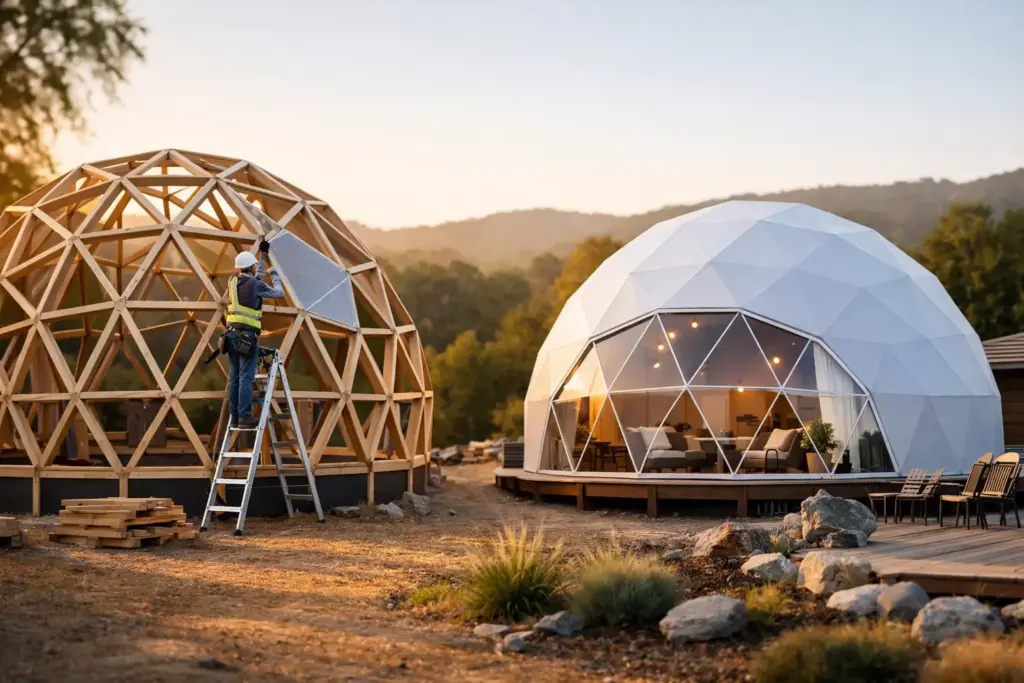
A well-designed dome built for commercial use can reduce several of those risks. Durable materials help limit maintenance frequency. Insulation and weatherproofing support broader seasonal use. Modular deployment can simplify expansion. Minimal site disruption may also reduce the hidden costs that come with larger, more invasive builds.
This does not mean every premium dome is automatically a wise investment. It means the right dome, in the right location, with the right positioning, should be evaluated as a revenue-generating hospitality product rather than a basic enclosure.
When Geodesic Domes Feel Expensive
There are cases where domes may feel expensive, and that should be said plainly.
If your market will not support premium nightly rates, a luxury dome may be overbuilt for demand. If your property has major access challenges or costly utility extension needs, the total installed cost can rise quickly. If you choose a high-end dome package but underinvest in the surrounding guest experience, the return may not meet expectations.
Domes can also feel expensive when buyers compare them to lower-tier alternatives that are not built for the same purpose. A seasonal shelter and a commercial-grade, insulated glamping unit should not be judged on price alone because they are solving different business problems.
In short, domes are expensive when the project model is weak, the product is mismatched to the market, or the comparison benchmark is unrealistic.
When They Make Strong Financial Sense
For many operators, geodesic domes make the most sense when they are used to create differentiated inventory without the drag of full conventional construction.
They work particularly well for boutique resorts, wellness retreats, nature-based hospitality concepts, and event venues looking to add overnight stays or flexible guest spaces. In those settings, the dome itself becomes part of the draw. Guests are not only paying for shelter. They are paying for atmosphere, architecture, immersion, and a stay that feels worth sharing.
That brand advantage matters. Distinctive accommodations tend to perform better in visual marketing, guest recall, and premium positioning. A well-placed dome with thoughtful finishes can command attention in a crowded market where standard rooms often blend together.
This is one reason premium suppliers such as StarWild Domes are positioned differently from commodity structure providers. In commercial hospitality, design, durability, ease of installation, and scalability all influence the investment outcome.
How to Judge Whether the Price Is Worth It
The smartest way to assess cost is to model the dome as an asset, not a line item. Look at your projected nightly rate, occupancy assumptions, season length, installation timeline, maintenance exposure, and how quickly the unit can begin operating.
You should also ask what alternative use of capital would achieve the same result. If a traditional build takes longer, costs more in labor, creates more site disturbance, and offers less visual distinction, the apparent savings may disappear.
It also helps to think beyond a single unit. Many hospitality businesses start with one or two domes, validate demand, and expand in phases. That staged approach can lower risk while building a property with a strong identity and clear revenue logic.
A premium dome is rarely the lowest-cost option on paper. But paper is not where hospitality performance happens. Guests respond to experience. Operators live with maintenance, seasonality, speed to market, and rate strategy. That is where the investment earns or disappoints.
So, Are Geodesic Domes Expensive?
Yes, they can be – especially when built to commercial standards, equipped for four-season use, and designed to deliver a premium guest experience. But expensive does not mean overpriced.
For the right property, geodesic domes can be one of the more intelligent ways to build your business: faster than many conventional structures, more distinctive in the market, and better aligned with the growing demand for nature-led luxury stays. The key is to judge them by total value, not just initial price.
If your goal is to create accommodation that guests remember, photograph, and book at a premium, the better question may not be whether a dome costs more. It may be whether a more ordinary structure can deliver the same return.