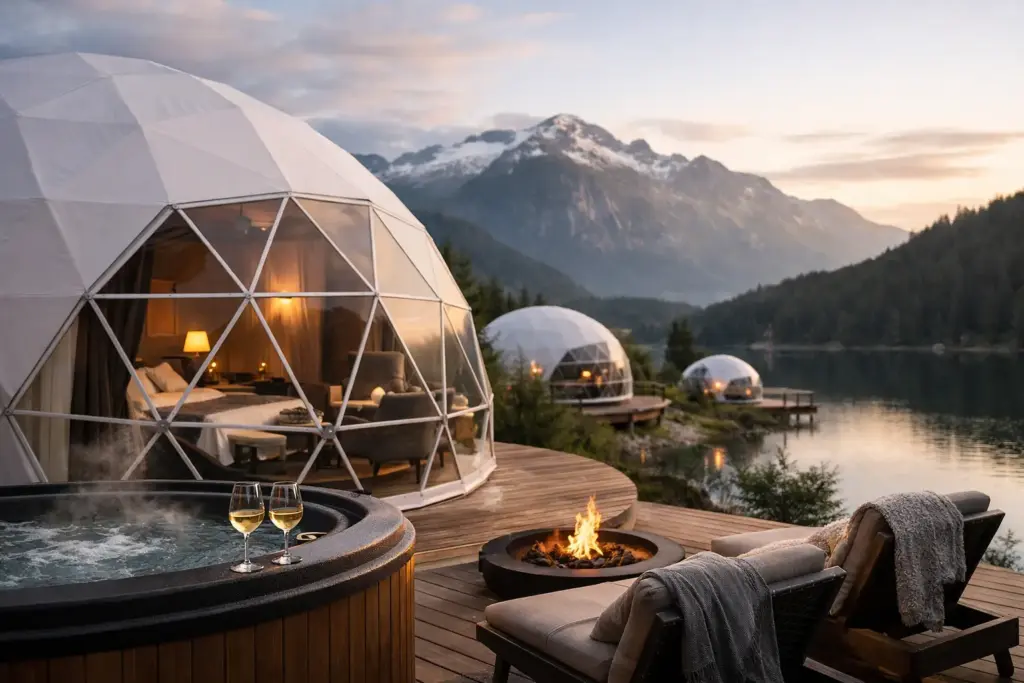
A guest may forget the square footage of a conventional room. They rarely forget waking beneath a panoramic ceiling as daylight moves through the trees, or watching a storm roll past from the comfort of a climate-controlled bed. That is the commercial advantage behind geodesic dome resorts: they turn a stay into a story guests are willing to seek out, share, and pay more for.
For resort owners, landowners, and retreat operators, the opportunity is not simply to add unusual accommodations. It is to create a high-value lodging category that connects privacy, design, and nature while avoiding much of the disruption associated with traditional construction. When planned with the right site, amenities, and operating model, a dome can become a revenue-generating asset with year-round potential.
The Experience Is the Product
Outdoor hospitality has moved beyond the idea that guests must choose between comfort and immersion. Premium travelers increasingly expect both. They want the quiet of a secluded setting, but they also expect a real mattress, a warm shower, thoughtful lighting, temperature control, and interiors that feel intentional rather than improvised.
A geodesic dome answers that expectation with a form guests immediately recognize as different. Its curved structure creates an expansive interior without relying on the visual language of a cabin, hotel room, or standard tent. Panoramic windows and optional transparent ceiling panels place the landscape at the center of the stay, whether that landscape is a forest, mountain property, desert, vineyard, lakeshore, or private wellness retreat.
That distinction matters because premium pricing begins with perceived value. A well-appointed dome offers more than a place to sleep. It can frame a proposal weekend, a restorative solo escape, a memorable family stay, or a small group retreat. The more clearly the accommodation supports an emotional reason to book, the less it competes on price alone.
Why Geodesic Dome Resorts Fit Modern Hospitality Growth
Adding conventional rooms can require extensive site work, long construction timelines, and a level of capital commitment that makes expansion difficult to stage. Geodesic dome resorts offer a more adaptable path for operators who want to test demand, launch a new concept, or expand in phases.
Modular dome structures can be installed with minimal site disruption compared with larger permanent builds, depending on local conditions and foundation requirements. This is especially valuable on land where preserving views, mature trees, natural drainage, or a sense of seclusion is central to the guest promise. Rather than reshaping the property around a building, operators can often position units to work with the terrain.
Scalability is another practical advantage. A property might begin with a small collection of signature suites, establish its booking performance, then add units as demand and operations mature. That approach can reduce the pressure to build an entire resort inventory before the concept has proven itself.
Relocation flexibility also deserves consideration. Hospitality owners do not always have certainty about the best placement for every unit. A dome that can be moved gives operators more room to respond to changing views, guest flow, event needs, seasonal conditions, or broader site development plans.
All-Season Use Protects Revenue Potential
A beautiful structure has limited business value if it can only perform during fair-weather weekends. For many North American operators, the strongest case for premium domes rests on their ability to support a longer operating season.
Quality geodesic domes are designed with durable frames, weatherproof exterior materials, insulation options, and efficient climate-control potential. These elements help create a comfortable guest environment through cold nights, summer heat, rain, wind, and shoulder-season conditions. The result is a property that can pursue occupancy beyond the narrow window associated with many seasonal glamping concepts.
Of course, year-round operation depends on more than the dome itself. Local climate, snow loads, wind exposure, utilities, road access, drainage, and maintenance practices all shape the final outcome. Operators should evaluate the complete site system early, including the guest path from parking to the unit and the infrastructure required to maintain comfort in challenging weather.
The payoff is meaningful. Extending availability by even a few high-demand weekends in spring, fall, or winter can improve annual revenue performance. A dome designed for four-season hospitality can also support seasonal programming that conventional tents cannot easily accommodate, from winter stargazing packages to autumn wellness retreats.
Design for Privacy, Not Just Photographs
The most successful dome resorts use visual appeal to earn attention, then use thoughtful planning to earn strong reviews and repeat bookings. A dramatic view is valuable, but privacy, convenience, and comfort determine whether the stay feels genuinely premium.
Begin with spacing. Guests should feel that they have arrived at a private sanctuary, not a row of units visible from one another’s decks. Orient entrances and panoramic windows away from neighboring accommodations where possible. Use topography, vegetation, pathways, and screening to preserve sightlines without compromising access.
Inside the dome, prioritize a clear hierarchy of space. The bed should command the view, while bathroom facilities, luggage storage, seating, and kitchen elements should support the stay without cluttering it. A generous outdoor deck, hot tub, fire feature, or private dining area can extend the experience and create additional reasons to book at a premium.
Amenities should match the property position. A remote adventure destination may benefit most from gear storage, outdoor showers, and easy trail access. A wellness retreat may place greater value on quiet treatment spaces, cold plunges, saunas, yoga platforms, and restorative finishes. An event-focused venue may need flexible gathering domes that complement overnight suites. The structure is versatile, but the guest proposition must be specific.
The Operating Details That Shape ROI
Strong ROI potential comes from the intersection of rate, occupancy, lifecycle cost, and operational simplicity. It is tempting to focus only on nightly price, particularly when distinctive stays command impressive rates on booking platforms. But a commercially sound project accounts for the full guest journey and the real cost of delivering it.
Utilities and housekeeping access should be planned before installation. So should waste management, laundry workflow, inventory storage, snow removal where relevant, lighting, security, and guest communication. A secluded dome may feel exclusive to a guest, but it cannot be so difficult to service that staff time erodes profitability.
It also helps to decide early whether each unit will be fully self-contained. Private bathrooms often support higher rates and broader guest appeal, but they require greater utility coordination and capital investment. Shared bath facilities can work well for a more social campground or wellness concept, yet they may limit the audience willing to pay luxury-level pricing. Neither model is automatically better. The right choice depends on the property, target guest, and desired rate position.
Operators should also budget for the elements that make a premium stay feel effortless: quality bedding, durable furniture, reliable Wi-Fi where promised, heating and cooling, tasteful finishes, and a maintenance plan for high-touch components. The dome shell creates the visual signature. Operational consistency protects the brand.
Building a Concept Guests Can Recognize
A collection of domes alone does not create a destination. The strongest properties pair accommodations with a clear point of view. Perhaps the property is a secluded stargazing retreat, a design-forward basecamp for outdoor exploration, a vineyard escape, or a wellness sanctuary built around rest and restoration.
That concept should guide every choice, from landscaping and interiors to photography, guest messaging, arrival rituals, and add-on experiences. A property with a defined identity is easier to market, easier for guests to recommend, and better positioned to command premium rates.
For multi-unit projects, consistency matters without becoming repetitive. Keep the quality standard high across every dome while giving guests a reason to choose one unit over another. A ridge-view suite, a family dome, a secluded honeymoon dome, and an accessible unit can serve different needs while sharing one elevated design language.
StarWild Domes supports this type of growth with premium, modular structures designed for outdoor hospitality projects that require durability, visual impact, and room to scale. The right dome partner should understand that operators are not buying a novelty structure. They are building an accommodation business.
Start With the Site and the Story
Before selecting a dome size or interior package, walk the property with two perspectives in mind: the guest arriving for an unforgettable escape and the operator responsible for delivering that escape every day. Look for the views worth framing, the areas that deserve protection, the routes staff can service efficiently, and the experiences your land can credibly offer.
The best geodesic dome resorts do not force luxury into nature. They give nature a more comfortable, memorable, and commercially powerful place in the guest experience.