A sold-out season exposes the same problem for many resort owners: demand is there, but inventory is not. The real opportunity is not simply adding more rooms. It is adding the right rooms, in the right sequence, with a model that protects capital and supports long-term growth. That is where scalable resort lodging solutions become a strategic advantage.
For outdoor hospitality brands, retreat operators, and landowners with expansion plans, scalability is not a design trend. It is a business framework. It shapes how quickly you can launch, how efficiently you can grow, and how confidently you can respond to changing demand without overcommitting to fixed construction.
What scalable resort lodging solutions really mean
Scalable resort lodging solutions are accommodation models designed to expand in phases rather than all at once. Instead of taking on the cost, timeline, and site disruption of a large conventional build, operators can introduce a smaller number of high-performing units, validate demand, and add inventory as revenue grows.
That matters because hospitality growth rarely moves in a straight line. One property may need six units now and twelve next year. Another may want to test a luxury wellness concept before expanding its retreat footprint. A third may need flexible structures for event season, then reposition the property around year-round stays. Scalability allows the lodging strategy to match the pace of the business.
The strongest models do more than add beds. They preserve the guest experience while making expansion practical. In premium outdoor hospitality, that often means structures that feel elevated and memorable, install with limited site disruption, perform in varied climates, and support repeatable deployment across multiple units.
Why traditional expansion often slows momentum
Conventional construction still has its place, especially for central amenities, food and beverage operations, or permanent service buildings. But when the priority is adding accommodation inventory quickly, it can create friction at every stage.
The first challenge is the timeline. Permitting, excavation, subcontractor coordination, and full build-outs can stretch for months or longer. That may be acceptable for a flagship lodge, but it is less appealing when the immediate goal is to capture near-term demand.
The second challenge is capital concentration. A large fixed build requires major upfront spending before the operator sees a return. That can pressure cash flow, limit expansion flexibility, and raise the stakes on occupancy assumptions.
The third challenge is land impact. Many resort and retreat properties derive their value from the landscape itself. Heavy construction can alter that setting, extend the disruption period, and complicate expansion in areas where guests expect a closer relationship with nature.
This is why many developers are shifting attention toward modular and lower-disruption accommodation formats. The appeal is not only speed. It is the ability to build your business with more precision.
The business case for premium modular lodging
Not all scalable lodging is equal. If added units are too basic, too seasonal, or too generic, they may increase capacity without lifting the brand. In the premium segment, new accommodations must do more than house guests. They need to justify rate, support distinctive positioning, and create a stay people remember.
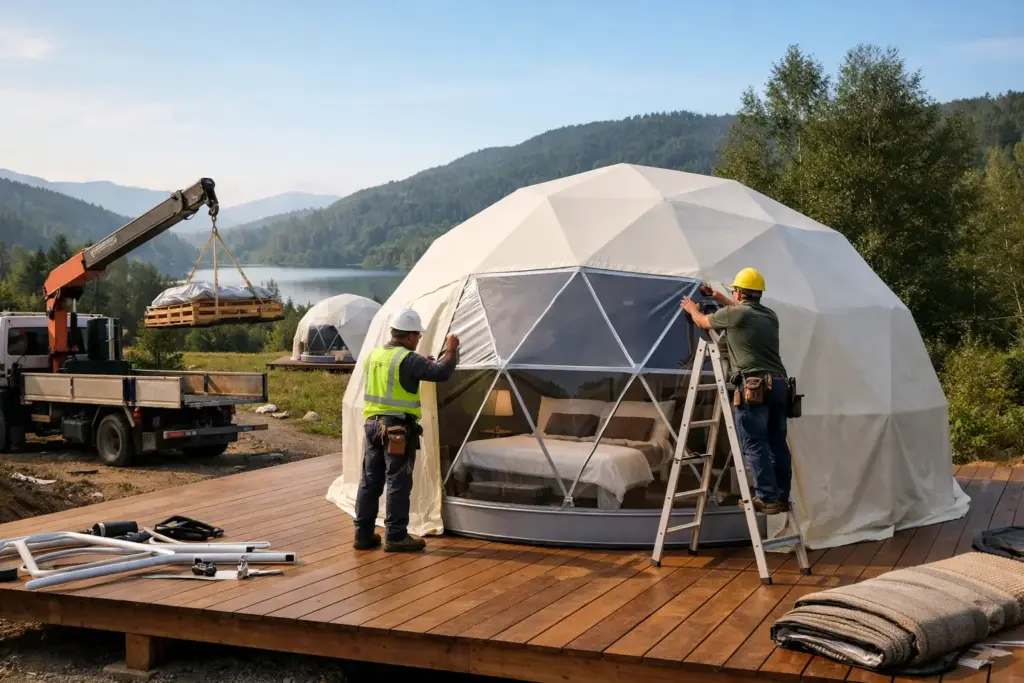
That is where luxury dome accommodations stand out. For operators in outdoor hospitality, they offer a rare balance: strong visual appeal, an immersive guest experience, and operational practicality. Panoramic architecture creates an immediate sense of arrival. Insulated, weather-ready construction supports four-season use in many environments. Modular deployment makes it possible to expand in phases rather than pausing growth until a full traditional build is complete.
There is also a revenue argument behind the aesthetics. Guests increasingly pay for experience, not just square footage. A well-sited dome with thoughtful interiors, privacy, and nature views can command premium nightly rates because it feels distinct from conventional hotel stock. That differentiation matters in crowded regional travel markets where standard accommodations compete heavily on price.
For property owners, the question is not whether a structure looks impressive in marketing images. It is whether it can perform as an asset. Premium modular lodging works best when design supports occupancy, installation supports efficient rollout, and durability supports lower long-term friction.
How to evaluate scalable resort lodging solutions
The most successful operators assess scalable lodging through both a guest lens and an investment lens. If either side is weak, the model will struggle.
Start with demand, not unit count
It is tempting to ask how many structures a property can fit. A better question is how many premium stays the market can absorb at the rate you need. A 20-unit expansion may sound ambitious, but if your market is still proving itself, a phased launch of four to eight units may produce better financial discipline and more room to refine the guest experience.
The right scalable model gives you that option. It should allow you to start with a high-impact core offering, then replicate what works.
Consider installation disruption
Every month of site work affects opening timelines, staffing plans, and guest perception. If your existing property is already operating, construction disruption becomes even more sensitive. Lodging solutions that reduce excavation intensity, shorten setup periods, and simplify deployment can preserve momentum while minimizing interference with current revenue.
Look at seasonality with clear eyes
Some structures photograph beautifully in fair weather but become operationally limiting in colder or wetter months. If your business case depends on shoulder season or year-round use, insulation, climate performance, and energy efficiency are not secondary details. They are central to revenue stability.
Of course, not every market needs four-season operation. In some regions, a high-performing seasonal model may still work well. The key is matching the lodging solution to the actual operating calendar rather than the idealized one.
Protect the rate through design
Scalability should never dilute the brand. If expansion produces units that feel repetitive, exposed, or under-designed, average daily rate can soften even as inventory rises. Premium lodging must still feel curated. Site planning, spacing, privacy, views, bathrooms, and interior finish all shape whether additional units strengthen the resort or weaken its position.
Growth in phases is often the smarter path
One of the biggest advantages of scalable resort lodging solutions is that they support measured expansion. That matters for new concepts and established properties alike.
A phased approach lets operators launch faster, gather booking data, understand guest behavior, and refine operations before adding more inventory. You learn which unit types perform best, which layouts create the most privacy, and which amenity combinations drive stronger reviews and better rate resilience.
This approach also improves decision-making around infrastructure. Rather than overbuilding utilities, pathways, and service capacity on day one, owners can align back-end investment with actual demand. That can preserve capital without limiting the long-term vision.
There is a trade-off, of course. Phased growth requires discipline. It may mean resisting the urge to overexpand early, even when market excitement is high. But for many hospitality businesses, steady and repeatable growth outperforms a single large bet.
Why domes fit the modern resort expansion model
Luxury dome structures align especially well with the needs of resorts and retreat properties looking to expand with elegance and efficiency. Their architectural presence helps create a premium identity from the start. Their modular nature supports repeatable rollout. Their lower-disruption installation profile helps protect the land that gives the property its value.
That combination is powerful for operators who want accommodations that feel elevated rather than temporary. It is equally valuable for investors who want clearer paths to revenue activation without the full burden of conventional room expansion.
For brands like StarWild Domes, the opportunity lies in pairing that guest appeal with commercial practicality: all-season performance, energy-conscious design, flexible deployment, and the ability to scale from a small launch to a multi-unit hospitality offering over time.
The properties best positioned to benefit
Not every site needs the same lodging strategy, but scalable models are especially compelling for properties with natural views, underused acreage, wellness positioning, event demand, or unmet premium lodging need in the surrounding market.
Resorts can use them to extend inventory without adding another standard building. Retreat operators can create private sanctuaries that support higher-value packages. Event venues can introduce overnight stays that turn single-day bookings into destination experiences. Landowners can move from raw land to revenue-generating hospitality with a more flexible first phase.
The common thread is simple: the property has something guests want to experience, and the lodging needs to bring them closer to it.
The best expansion decisions are rarely about adding the most units the fastest. They are about creating accommodations that lift the brand, respect the landscape, and grow with confidence. If your property is ready for its next chapter, choose a lodging model that earns today’s demand without limiting tomorrow’s vision.