A beautiful piece of land is not yet a hospitality business. The difference lies in how well the experience, infrastructure, and revenue model are shaped from the start. This outdoor hospitality development guide is built for owners and operators who want more than cabins in the woods or tents on a field. It is for those creating a destination – one that feels elevated, efficient to run, and compelling enough to command premium nightly rates.
The strongest outdoor hospitality concepts begin with a clear commercial idea. Not just what will be built, but why guests will choose it, photograph it, return to it, and recommend it. A property can have remarkable views and still underperform if the guest offer is vague. It can also be modest in size and outperform larger competitors if every decision supports a defined experience.
What an outdoor hospitality development guide should solve first
Before design boards and site maps, start with market position. Are you building a romantic retreat for couples, a wellness destination, an event-driven property, or an upscale family resort? Each path influences everything that follows, from unit spacing to bathhouse strategy to the level of privacy guests expect.
This is where many projects drift off course. Developers often focus on the structure first and the business model second. In practice, the opposite creates stronger outcomes. Your accommodations should support the concept, the pricing strategy, and the operating model. If your goal is premium ADR, the physical product has to justify it through design, comfort, and distinctiveness.
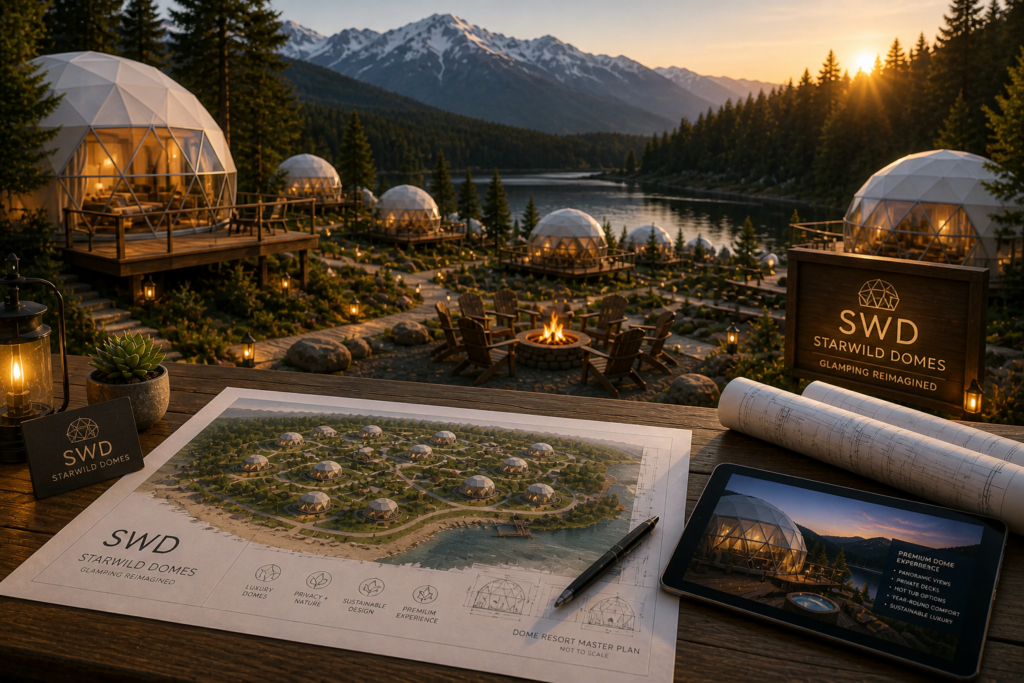
For many operators, luxury dome accommodations fit this requirement especially well. They offer architectural appeal, panoramic guest experiences, and a lighter development footprint than traditional construction. Just as important, they can help launch faster and expand in phases, which matters when you are protecting capital while testing demand.
Start with the land, but read it like an operator
Not every attractive parcel is ready for hospitality. The right site is not only scenic. It is serviceable, accessible, and practical to develop. Topography, drainage, utility access, vehicle circulation, and emergency access all affect cost and guest experience.
A steep ridge may look spectacular in marketing photos, but it can complicate installation, increase infrastructure spending, and create maintenance headaches. A meadow with easier access may produce a better return even if it feels less dramatic at first glance. In outdoor hospitality, the best site plan often balances visual impact with operational ease.
Privacy also matters more than many first-time operators expect. Guests are paying for nature, but they are also paying for quiet, personal space, and a feeling of retreat. Unit placement should preserve sightlines while reducing noise overlap. The more intentional the spacing, pathways, and orientation, the more premium the property will feel.
Design for revenue, not just for aesthetics
In hospitality, beauty has a job to do. It should increase occupancy, support stronger rates, and shape a guest stay that feels worth sharing. Signature accommodations can help create this effect, but only if they are paired with smart planning.
That means considering what guests actually use. Climate control, insulation, private bathrooms, power, lighting, and weather protection have a direct effect on reviews and repeat bookings. Year-round comfort is especially important in many US markets, where shoulder season and winter revenue can make the difference between a novelty concept and a durable business.
This is also where structure choice becomes strategic. Traditional construction may suit some sites, especially where permanence and local architectural continuity are priorities. But for many hospitality developers, modular or semi-modular dome structures offer a more agile path. They reduce disruption, install faster, and allow phased growth without committing to a full buildout on day one.
That flexibility matters. A property with three to five premium units can prove demand, refine operations, and build brand presence before expanding. It is a more disciplined approach than overbuilding early and hoping occupancy catches up.
The outdoor hospitality development guide to infrastructure decisions
Guests may arrive for the view, but infrastructure determines whether the business runs smoothly. Water, wastewater, electrical service, internet access, internal roads, parking, and staff circulation should be addressed early, not treated as secondary layers.
This is often the least glamorous part of development, yet it shapes both cost and guest satisfaction. A refined accommodation experience loses value quickly if guests struggle with muddy paths, inconsistent hot water, or poor lighting at night. Premium hospitality depends on invisible competence.
There is also a capital allocation question here. Some developers invest heavily in shared amenities first. Others prioritize private in-unit features. Which approach works best depends on your audience. Couples seeking privacy may value ensuite bathrooms and secluded decks more than a large communal lounge. Group retreat properties may benefit more from gathering spaces, wellness facilities, and event infrastructure.
The right answer is rarely universal. It depends on your pricing model, operational bandwidth, and how long guests are expected to stay.
Permitting, timelines, and why speed matters
Outdoor hospitality rewards momentum. The faster you can move from concept to opening, the sooner you can test rates, build occupancy, and start generating cash flow. That does not mean rushing. It means choosing a development path that aligns with your market window and capital plan.
Permitting can be one of the largest variables. Local jurisdiction, land-use rules, building requirements, health regulations, and environmental considerations all affect timeline and feasibility. Some sites are straightforward. Others require more patience, more professional coordination, and more budget discipline.
This is another reason many developers favor alternative accommodation models over conventional builds. Solutions that allow easier installation and minimal site disruption can shorten project timelines and reduce complexity. For operators entering the market or adding inventory to an existing resort, that speed can create a real competitive advantage.
A delayed opening does more than push back revenue. It can miss peak booking seasons, increase carrying costs, and weaken launch momentum. Good development planning protects against that.
Build an experience guests will pay more for
A successful outdoor stay is not only about shelter. It is about atmosphere. The soundscape, the arrival moment, the lighting after sunset, the layout of the room, the quality of sleep, and the sense of connection to the landscape all influence how guests value the experience.
Premium outdoor hospitality performs best when it gives guests something they cannot easily get from a standard hotel. That could be a transparent ceiling panel for stargazing, a private deck facing the forest, a spa-oriented bathing experience, or interiors that feel calm and architectural rather than rustic and improvised.
This is where design-forward accommodations earn their place. Luxury domes, for example, offer a visual identity that helps a property stand apart while still supporting operational practicality. For developers who want distinctive inventory without the weight of extensive conventional construction, that can be a strong commercial move. StarWild Domes speaks directly to this segment by pairing premium aesthetics with durable, insulated structures designed for scalable hospitality use.
Still, differentiation should be disciplined. Not every memorable feature produces a return. Invest in what improves guest perception, pricing power, and booking appeal. Skip novelty that raises maintenance costs without strengthening the stay.
Plan operations before opening day
Some hospitality concepts look compelling in renderings and become difficult the moment guests arrive. The usual reason is operational friction. Housekeeping routes are inefficient. Supplies are hard to store. Staff spend too much time traveling across the property. Guest questions reveal that wayfinding is unclear.
Strong operators think about these realities during development, not after launch. Where will linens go? How will maintenance access each unit? Can a unit be turned efficiently between guests? Is there enough resilience for weather events, seasonal demand swings, or utility interruptions?
This operating lens is essential if you plan to scale. One or two units can be managed informally. A larger property needs systems. The most valuable accommodation assets are not only beautiful to market. They are workable to run on.
Think in phases, not just in openings
Many of the best outdoor hospitality businesses do not begin at full size. They begin with a focused first phase, then expand once performance data supports the next move. This protects capital, reduces exposure, and creates room for refinement.
A phased strategy also lets you respond to guest behavior. You may learn that private wellness features outperform communal amenities, or that couples’ stays are stronger than family bookings, or that shoulder season demand is better than expected. Those insights can shape the next round of units and improve return on future investment.
The structure system you choose has a major effect on this flexibility. Accommodations that are modular, relocatable, or faster to deploy make phased expansion far more practical. They give you room to grow with confidence rather than force every major decision upfront.
An outdoor hospitality property succeeds when vision and discipline work together. The land must feel special, but the economics must be sound. The design should feel elevated, but the operations must stay manageable. If you build with both guest experience and commercial clarity in mind, the result is more than a place to stay. It becomes a business with staying power.