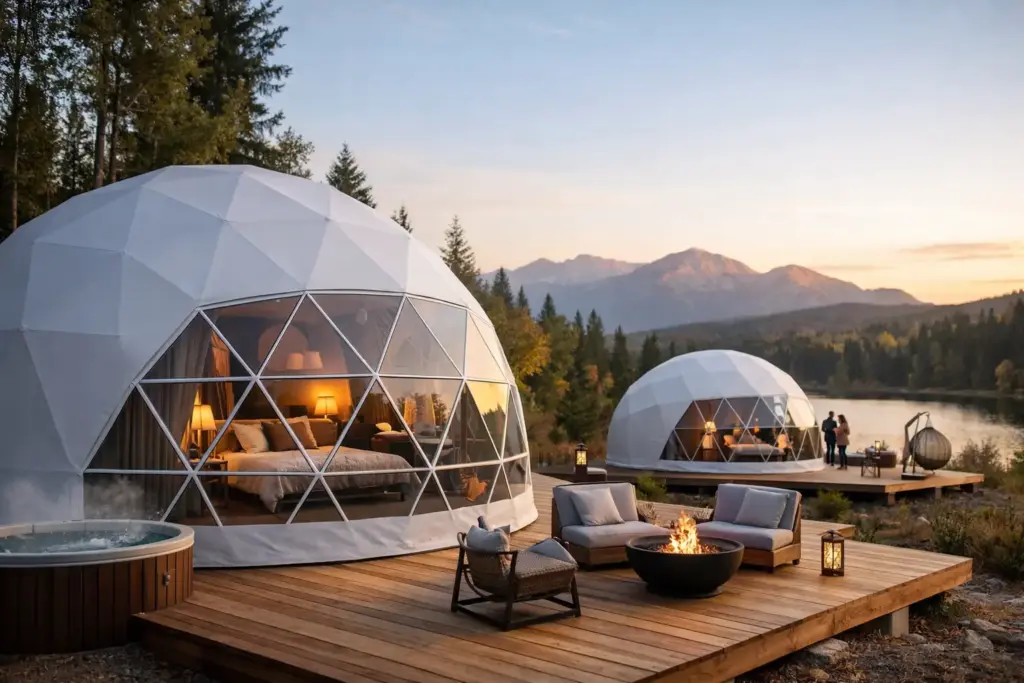
A vacant hillside, a forest clearing, a lakeside parcel – these are not just scenic backdrops. For hospitality operators, they are revenue opportunities waiting for the right structure. That is why interest in luxury glamping domes for sale has grown so quickly among resort owners, retreat founders, and land developers looking to expand lodging without the long timeline and disruption of traditional construction.
The appeal is easy to understand. Guests want immersive stays that feel elevated, private, and memorable. Operators need accommodations that are durable, efficient, and capable of generating strong returns. A well-designed glamping dome sits at that intersection, offering the visual impact of a distinctive guest experience with the practical advantages of modular deployment, all-season performance, and lower site disturbance.
Why luxury glamping domes for sale are attracting serious buyers
The market has moved well beyond novelty. In outdoor hospitality, premium domes are now being evaluated as business assets, not temporary experiments. They allow operators to create a high-end stay that feels close to nature while maintaining the comfort standards guests are willing to pay for.
That matters because nightly rates are driven by more than square footage. They are shaped by experience, design, privacy, and perceived exclusivity. A dome with panoramic views, refined interiors, and year-round usability can command attention in a crowded lodging market. For a retreat property or boutique resort, that differentiation can translate into stronger occupancy and better pricing power.
There is also a strategic advantage in speed. Traditional builds often involve longer permitting cycles, more invasive construction, and higher complexity across trades. Dome structures can offer a more agile path, especially for operators who want to test a concept, open inventory sooner, or scale in phases rather than commit to a large buildout all at once.
What separates a premium dome from a basic structure
Not every dome belongs in a commercial hospitality setting. Buyers looking at luxury glamping domes for sale should be careful not to confuse visual appeal with operational readiness. A structure may look striking in photos and still fall short where it counts most – weather resistance, insulation, longevity, maintenance, and guest comfort.
A premium hospitality dome should first be built for real use, not occasional leisure. That means a durable frame, weatherproof exterior materials, and insulation suited to all-season occupancy. In North America, where climate conditions vary sharply by region, this is not a minor detail. A dome that performs beautifully in mild weather may become a liability in heavy snow, strong winds, intense summer heat, or shoulder-season cold.
Energy efficiency also deserves close attention. Operators do not just buy a structure – they buy into an operating model. If heating and cooling costs are high, margins narrow. If condensation or temperature swings affect guest comfort, reviews suffer. Better dome systems are designed to support stable interior conditions with less energy strain, which protects both the guest experience and the long-term economics of the unit.
Then there is the interior feeling. True luxury is rarely about excess. It is about proportion, light, acoustics, privacy, and the quality of the stay. Panoramic doors, transparent ceiling panels, and thoughtful layouts can transform a dome from an interesting shell into a premium suite that guests remember and share.
The business case for buying domes instead of building cabins
For many operators, the real comparison is not dome versus tent. It is a dome versus a cabin, cottage, or small-format lodge. This is where the investment discussion becomes more practical.
Cabins can offer permanence and familiarity, but they often come with higher upfront costs, more site work, longer construction schedules, and less flexibility. If a market shifts, a site plan changes, or a phased rollout becomes necessary, fixed construction gives you fewer options.
Luxury domes create a different kind of value. They can often be installed with less disruption to the land, brought online faster, and expanded more easily as demand grows. That flexibility is especially useful for operators entering a new market, activating underused acreage, or testing premium outdoor lodging before scaling across a property.
Relocation potential also matters more than many buyers expect. Hospitality businesses evolve. Event spaces become overnight destinations. Seasonal sites become year-round operations. Land use plans change. A dome system that supports modular deployment and future repositioning gives owners strategic room to adapt without abandoning the asset.
Where domes fit best in hospitality projects
The strongest dome projects are usually clear about their commercial purpose from the start. Some properties use domes as flagship guest suites that raise the profile of the entire resort. Others add them as wellness spaces, spa rooms, dining environments, or event lounges that create premium experiences beyond lodging alone.
For retreat operators, domes can shape the identity of the brand. A forest meditation dome, a private couples suite, or a stargazing accommodation has immediate emotional appeal, but the business value comes from how well it fits the pricing model and guest journey. The most successful installations are not random additions. They are integrated into the property’s positioning, operations, and revenue strategy.
Venue developers are also paying attention. A dome can serve as a ceremony space, cocktail setting, bridal suite, or private hospitality environment that sets an event property apart. When that same structure can support multiple uses across the year, the return profile becomes even more attractive.
What buyers should evaluate before purchasing
A dome purchase should begin with the site and the business model, not just the product brochure. Climate, access, terrain, utilities, target ADR, guest segment, and seasonality all affect what kind of structure makes sense.
A high-end couples retreat in a wooded mountain setting may prioritize privacy, insulation, and a dramatic view wall. A multi-unit resort expansion may need repeatable configurations, efficient installation sequencing, and a supplier that can support scale. An event-focused venue may care most about visual impact, layout flexibility, and quick deployment with minimal interruption to existing operations.
This is why the best buying decisions are rarely based on unit price alone. Lower initial cost can be appealing, but it means less if the structure underperforms, requires frequent maintenance, or limits your ability to operate in colder months. Over time, those compromises can cost more than they save.
Support matters too. A supplier should understand not only the structure itself but also the realities of hospitality development – timelines, guest expectations, installation planning, and future expansion. For commercial buyers, that level of partnership is often as valuable as the dome.
A luxury dome should strengthen both brand and margins
The most compelling hospitality investments do two things at once. They elevate the guest experience and improve the business. That is the standard luxury glamping domes should meet.
When chosen well, they create a sense of escape that feels rare enough to justify premium pricing. At the same time, they can reduce development friction, preserve more of the natural setting, and open a faster path to revenue. That combination is why serious operators across the US and Canada are looking closely at this category.
For buyers who want more than a beautiful structure, the question is not simply whether a dome looks impressive. It is whether it can support your concept, perform in your climate, and contribute to a lodging model with strong ROI potential. Brands such as StarWild Domes are part of that conversation because they position the dome not just as accommodation but as a scalable hospitality asset.
If your property has views, privacy, and a story worth staying for, the right dome can help turn that landscape into a destination guests will book for the experience and remember for the feeling.